


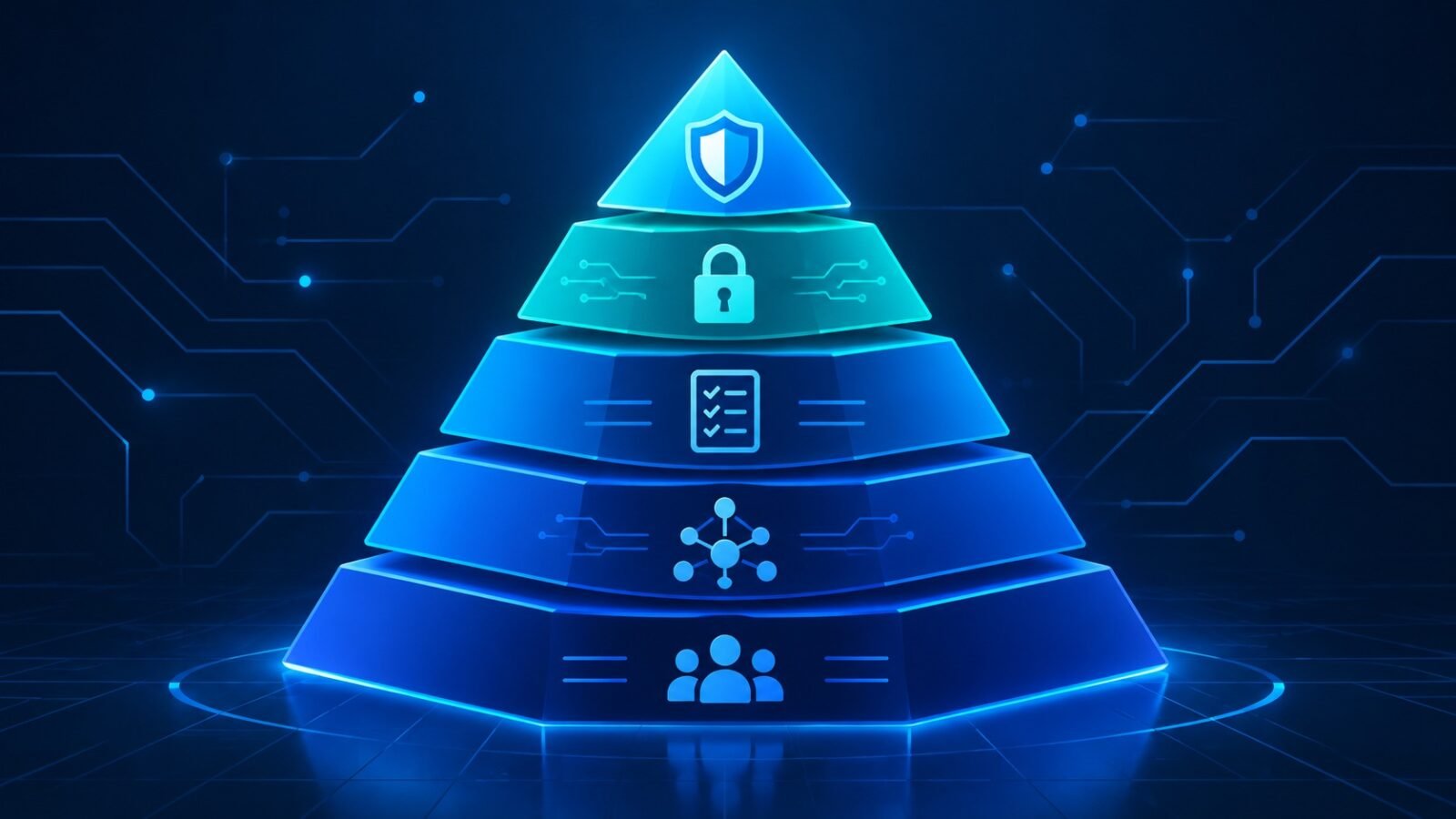
Most organizations approach information security the wrong way, they do not even know How to Structure an Infosec Program for a New Org, they buy tools first and ask strategic questions later. A firewall gets provisioned, an endpoint agent gets deployed, and someone eventually wonders whether any of it maps to actual business risk. For a new organization building from scratch, that backwards approach is an opportunity in disguise: you have no legacy decisions to undo.
Table of Contents
Foundational Infosec Program requires for Structure an Infosec Program
A foundational infosec program is not a technology project. It is a risk management discipline that uses technology as one of several controls. Before your team evaluates a single vendor, the program needs three things to be credible: a defined scope, an honest assessment of what the organization is protecting, and executive alignment on how much risk is acceptable. Without those three anchors, every subsequent decision, hiring, tooling, policy, floats free of any objective standard.
Scope is where most new programs fail quietly. Defining scope means identifying what assets, systems, data types, and business processes fall under the security program’s responsibility. This is not the same as listing everything the company owns. A startup processing payment card data has a materially different scope than a healthcare SaaS company storing protected health information, even if both run on similar cloud infrastructure. Scope determines which regulatory frameworks apply, which threat actors are relevant, and what your security team is actually accountable for defending.
The risk tolerance conversation is the other foundational requirement that gets skipped — usually because it requires bringing executives into a room and asking them uncomfortable questions. How much downtime is the business willing to absorb? What data, if lost or exposed, would threaten the company’s existence? Which regulatory violations carry existential penalties versus manageable fines? These are not questions a security team can answer alone, and pretending otherwise produces a program that is technically thorough but organizationally disconnected. Executives who never had the risk tolerance conversation will always be surprised by security incidents, and surprised executives make bad decisions under pressure.
It is also worth being direct about what a foundational program is not. It is not a compliance checklist you work through once and file away. It is not a policy document that lives in a shared drive unread. And it is not something that can be fully delegated to a managed service provider while leadership stays uninvolved. If the security program exists only to satisfy an auditor’s question, it will protect the organization from auditors — not from actual threats.
For anyone who wants to understand how information security fits into the broader discipline of protecting organizational assets, the overview of information security and its role in cybersecurity provides useful grounding before diving into program structure.
The sections that follow treat each building block of a new infosec program in sequence — structure, governance, tooling, and measurement — because the order in which you build these things matters as much as whether you build them at all.
Building the Information Security Division
Once scope is defined and leadership has agreed on acceptable risk, the next question is deceptively practical: who actually does this work, and who do they answer to?
Core Roles and Reporting Lines
A new infosec division does not need to be large to be effective, but it does need clear accountability from day one. At minimum, a functioning program requires someone responsible for policy and risk oversight, someone handling day-to-day operational security (monitoring, incident response, vulnerability management), and someone who can translate security requirements into the technical environment — whether that is a dedicated security engineer or a network-savvy systems administrator wearing a second hat.
Reporting lines matter more than most founders and COOs expect. Security leadership that reports directly to the CEO or board carries institutional authority; security leadership buried beneath the CTO or CIO faces an inherent conflict of interest whenever security requirements slow down engineering velocity or IT projects. Neither arrangement is universally wrong, but the organization should make the choice deliberately rather than by default.
CISO vs. vCISO: Choosing the Right Leadership Model
For most organizations in their first one to three years, a full-time Chief Information Security Officer is an expensive hire that arrives before the program is mature enough to justify it. A virtual CISO — an experienced security executive engaged on a fractional or retainer basis — gives early-stage organizations strategic leadership, board-level credibility, and framework knowledge at a fraction of the cost. The tradeoff is availability: a vCISO is not on-call for your incidents the way a full-time hire would be.
The decision should hinge on two variables: how regulated your industry is, and how frequently leadership needs security input. A fintech handling payment data or a healthcare startup dealing with protected health information will likely reach the threshold for a full-time CISO sooner than a SaaS company in an unregulated vertical. When the volume of compliance obligations, audit cycles, and vendor security reviews fills more than a part-time engagement, it is time to hire.
When to Build In-House vs. Outsource Security Functions
Not every security function belongs inside the organization, especially early on. Managed detection and response, penetration testing, and security awareness training are mature service categories where external providers typically deliver better coverage and expertise than a lean internal team could build quickly. The functions that generally belong in-house from the start are policy ownership, risk management, and vendor security review — because these require institutional context that an outside provider will never fully develop.
A practical heuristic: if a function requires deep knowledge of your internal systems, culture, and risk appetite to do well, keep it internal. If it requires specialized tooling and around-the-clock staffing you cannot afford to replicate, outsource it and own the oversight layer yourself. Understanding how network security functions interlock with broader security operations can help clarify which operational functions are candidates for managed services versus those that demand internal expertise.
The goal at this stage is not a complete security organization — it is a coherent one, with defined ownership, no critical gaps in accountability, and a structure that can grow as the program matures.
Governance, Policy, and Compliance Frameworks
Once your organizational structure is in place, governance gives it teeth. Without documented policies, defined accountability, and a framework that maps to your actual risk environment, a security organization is little more than a headcount — reactive by default and difficult to scale or audit.
Selecting a Control Framework (NIST CSF, ISO 27001, SOC 2)
The first governance decision is choosing a control framework to organize your program around. The three most common options for new programs are the NIST Cybersecurity Framework (CSF), ISO 27001, and SOC 2 — and they serve different purposes.
NIST CSF is a flexible, non-prescriptive framework organized around five functions: Identify, Protect, Detect, Respond, and Recover. It is widely used by U.S. organizations across sectors, requires no formal certification, and is a strong starting point if your primary goal is internal program coherence rather than demonstrating compliance to a third party.
ISO 27001 is an international standard that results in a formal, auditable certification. It demands a full information security management system (ISMS) and is better suited to organizations with global customers or contractual requirements that call for a recognized credential.
SOC 2 is not a framework in the traditional sense — it is an audit report evaluating controls against the AICPA’s Trust Services Criteria. It is most relevant for SaaS companies and technology vendors whose enterprise customers will eventually require it as a condition of doing business.
For most new infosec programs, starting with NIST CSF and then layering SOC 2 or ISO 27001 as customer or regulatory pressure demands is a pragmatic path. Trying to achieve ISO 27001 certification before your processes are mature enough to sustain an ISMS will generate paperwork, not security.
Drafting Your First Information Security Policy Set
Framework selection and policy drafting happen in parallel, not in sequence. Your policy set is the formal expression of how your organization implements the framework’s requirements. A minimal first set should cover: an overarching information security policy, an acceptable use policy, an access control policy, an incident response policy, and a data classification policy.
Policies should be precise enough to be enforceable and short enough to be read. A well-structured cybersecurity policy for your organization begins with a clear statement of scope and ownership — if it is not clear who is accountable for a policy requirement, the policy will not be followed. Schedule reviews annually at minimum, and tie each policy to the control framework control it satisfies so you can demonstrate coverage during audits.
Mapping Regulatory Requirements to Your Industry
Framework and policy work does not happen in isolation from regulatory reality. Depending on your industry and the data you handle, specific regulations will impose obligations that sit on top of any framework you choose. Healthcare organizations must account for HIPAA. Companies processing payment card data face PCI DSS. Organizations handling EU resident data must address GDPR requirements regardless of where they are headquartered.
The practical approach is to build a regulatory inventory early — a simple matrix that maps the jurisdictions you operate in, the data types you process, and the regulations that apply. Gaps between your chosen framework and your regulatory obligations become your first remediation backlog. Identifying those gaps before you build tooling or hire staff prevents costly rework later and gives your program a documented, defensible starting point for any future audit or regulatory inquiry.
Technology Stack and Tooling Priorities
Selecting your initial technology stack is one of the highest-leverage decisions a new infosec program makes, and also one of the easiest to get wrong. Buying tools before you’ve defined scope and risk tolerance — which the earlier sections of this guide address — almost guarantees redundancy, coverage gaps, or both.
Tier-One Tools Every New Infosec Division Needs
Before evaluating vendors, map your tooling to the control categories your chosen framework requires. That mapping exercise will surface five functional areas that virtually every new program needs to address first.
Identity and access management is the logical starting point. If you cannot enforce who has access to what, every other control is undermined. At minimum, this means a centralized directory, multi-factor authentication across all user-facing systems, and a privileged access management solution for administrative accounts.
Endpoint detection and response (EDR) gives your team visibility into the devices most likely to be the initial point of compromise. Modern EDR platforms go well beyond traditional antivirus — they provide behavioral telemetry, investigation timelines, and, in many cases, automated containment. For a small team, choosing an EDR with a strong managed detection and response (MDR) option preserves flexibility as headcount grows.
Security information and event management (SIEM), or a lighter-weight log aggregation platform for organizations not yet ready to operationalize a full SIEM, ensures you have a centralized record of events across your environment. Without this, incident investigation becomes a manual, time-consuming reconstruction exercise. Start with whatever you can actually monitor and tune — an expensive SIEM generating unreviewed alerts provides almost no security value.
Vulnerability management closes the loop between your asset inventory and your patching processes. A scheduled scanning cadence, combined with a defined remediation SLA by severity, is a basic expectation of virtually every compliance audit you will face.
Email security and DNS filtering address the two delivery vectors responsible for the large majority of initial access attempts. Both are relatively inexpensive and should be considered table stakes before you spend budget anywhere else.
Avoiding Tooling Sprawl in the Early Stage
The vendor market for security products is saturated, and new programs are a frequent target for aggressive sales cycles. Platform consolidation — choosing vendors that cover multiple functional areas rather than buying point solutions for each — reduces integration overhead, licensing complexity, and the cognitive load on a small team.
A useful rule for early-stage programs: no new tool without a defined owner, a documented use case, and a metric that tells you whether the tool is working. If you cannot answer all three questions before purchase, defer the evaluation.
Firewall selection is one area where the range of available options can be particularly confusing for new programs — understanding the differences between next-generation firewall capabilities matters before committing to a platform that will sit at the center of your network architecture for years.
Revisit your tooling decisions at six and twelve months. The tools that made sense at program launch may not serve you well once your asset inventory grows, your team expands, or your compliance requirements evolve. Building a deliberate review cadence into your security roadmap prevents you from carrying dead weight indefinitely.
Measuring Program Maturity and Reporting to the Board
A security program that cannot explain its own value to the people holding the budget will always struggle for resources. Measuring maturity and communicating progress to executive leadership and the board is not a reporting formality — it is how a new infosec function earns organizational trust and sustained investment.
Key Performance Indicators and Metrics That Matter
The first instinct for many new security leaders is to report activity: tickets closed, alerts reviewed, patches deployed. These operational metrics matter internally, but they rarely land with a board audience. Executives and directors need to see risk posture, not workload.
Structure your metrics around three questions the board actually cares about: How exposed are we right now? Is our exposure trending better or worse over time? How does our program compare to what our industry peers and regulators expect?
Useful leading indicators include mean time to detect and mean time to respond for security incidents, percentage of critical and high vulnerabilities remediated within a defined SLA window, and coverage rates for endpoint detection, MFA enrollment, and security awareness training. These give leadership a forward-looking sense of whether controls are working before something breaks.
Lagging indicators — the number of confirmed incidents in a quarter, near-misses that required escalation, audit findings — tell the story of what has already happened. Both sets belong in your reporting, because leading metrics without outcomes look theoretical, and incident counts without context look alarming. Frame them together so the board understands direction, not just data points.
Avoid vanity metrics. A 99% patch compliance figure is meaningless if the remaining 1% are your crown-jewel systems. Be selective about what you surface upfront, and be honest when a metric is trending the wrong way — boards remember the leaders who flagged problems early far more favorably than those who managed the optics.
Building a Security Roadmap with Budget Justification
A security roadmap translates your current program state into a credible, time-bounded plan for where you need to be. For a new organization, this document serves double duty: it guides the security team’s priorities and it makes the budget case to finance and the C-suite.
Start with your control framework gap analysis. Whatever framework you selected — NIST CSF, ISO 27001, or SOC 2 — map your current control coverage against it honestly and document the gaps in plain language, not compliance jargon. Each gap becomes a candidate initiative. Prioritize by risk reduction potential and cross-reference against your regulatory obligations so the highest-stakes gaps rise to the top.
Attach a cost estimate and an expected risk reduction to each initiative. This forces rigor on your team and gives leadership a basis for tradeoff conversations rather than line-item debates. A proposal that says “deploying privileged access management closes our highest-severity finding from last quarter’s audit and reduces our exposure in three mapped risk categories” is far more defensible than one that simply requests a budget number.
Build your roadmap in phases — typically twelve, twenty-four, and thirty-six months — and revisit it quarterly. The threat landscape changes, business priorities shift, and a roadmap that isn’t updated becomes a document people stop trusting. Treat it as a living artifact, and present updates to the board on a cadence that matches how often they review other major business plans.
How many people do you need to staff a basic information security division?
There is no universally verified minimum headcount that applies across all organization sizes and risk profiles, and citing a specific number without a credible source would be misleading. A practical starting point is one dedicated security lead (or a virtual CISO) plus shared responsibility across IT staff, scaled upward based on regulatory requirements, data sensitivity, and organizational size. We do not have a verified source to cite a precise figure here.
Should a new organization hire a full-time CISO or use a virtual CISO service?
For most early-stage or small organizations, a virtual CISO (vCISO) offers strategic security leadership at a fraction of the cost of a full-time hire, which is valuable when budget and headcount are limited. A full-time CISO becomes more justifiable as the organization grows, faces significant regulatory obligations, or handles sensitive data at scale requiring dedicated, on-site oversight. The right choice depends on budget, risk exposure, and how quickly the security function needs to mature — there is no single correct answer without knowing those variables.
Which security framework is best for a new organization with no prior infosec program?
The NIST Cybersecurity Framework (CSF) is widely recommended as a starting point for organizations with no existing infosec program because it is risk-based, flexible, and not prescriptive about specific technology controls — NIST publishes it openly at nist.gov. For organizations subject to specific regulations, frameworks like ISO/IEC 27001 or the CIS Controls may be more appropriate anchors, and the CIS Controls in particular offer a prioritized, implementation-friendly structure suited to resource-constrained teams. No single framework is universally ‘best,’ and the right choice depends on your industry, regulatory environment, and existing IT maturity.
What is the first security policy a new organization should write?
An Acceptable Use Policy (AUP) is commonly cited as the foundational first policy because it establishes baseline rules for how employees may use organizational systems, networks, and data — setting the behavioral and legal groundwork for everything that follows. An Information Security Policy (sometimes called an overarching or master security policy) is an equally strong candidate, as it defines the organization’s security objectives, scope, and governance structure that all other policies flow from. In practice, these two are often developed together as the cornerstone of a new program, though we do not have a verified authoritative source to definitively rank one above the other.
How do you build an infosec program on a limited budget?
Prioritization is the core discipline: start with a risk assessment to identify your highest-impact threats, then address those first rather than trying to build a comprehensive program all at once. Leverage no-cost or low-cost resources such as the CIS Controls (available free from cisecurity.org), open-source security tools, and cloud-native security features already included in platforms your organization uses. A vCISO engagement, staff security awareness training, and enforcing strong identity controls like multi-factor authentication typically deliver the highest risk reduction per dollar spent in early-stage programs.







Leave a comment