


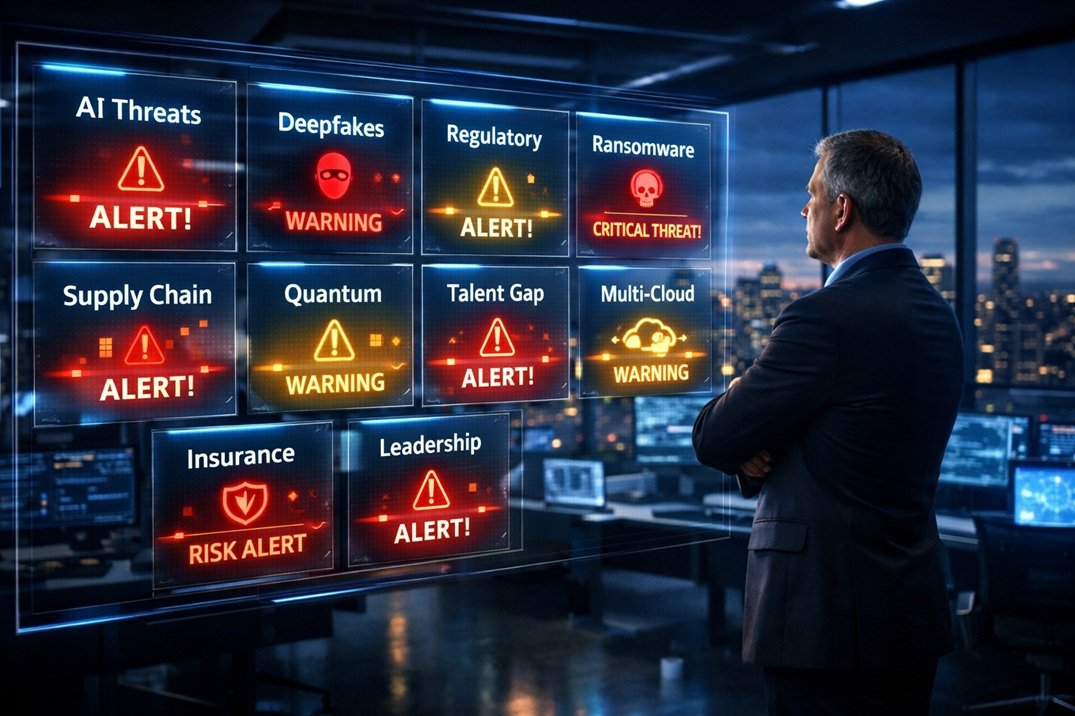
Welcome to 2026, where being a Chief Information Security Officer means navigating an impossible paradox: threat sophistication is growing exponentially while budgets, talent pools, and executive patience remain stubbornly finite.
The CISO’s Dilemma: Too Many Threats, Not Enough Resources
You’re in the boardroom. The CFO just asked you to justify your $15 million security budget increase while the CEO wants to know why last quarter’s phishing simulation showed a 42% click rate despite years of awareness training. Meanwhile, your phone buzzes with three critical alerts: another zero-day exploit, a regulatory compliance deadline you didn’t know existed, and news that your primary security vendor just suffered a breach.
The cybersecurity landscape has fundamentally shifted. According to Gartner’s 2026 Security and Risk Management Trends, 70% of CISOs report feeling overwhelmed by the volume and complexity of threats, while 63% struggle to communicate cyber risk effectively to non-technical executives. The traditional playbook of “prevent, detect, respond” no longer works when adversaries deploy AI at scale, when your attack surface extends to thousands of cloud services, and when a single misconfigured API can expose millions of customer records.
This isn’t just another trend report. These are the ten cybersecurity developments that will define whether your organization thrives or becomes another headline in 2026. Each represents a strategic inflection point requiring immediate CISO attention, board-level discussion, and substantial resource allocation.
The CISOs who succeed in 2026 won’t be those who try to defend everything. They’ll be those who understand which battles matter most and allocate their limited resources accordingly.
Table of Contents
Development 1: Agentic AI Attacks Surpass Human-Executed Threats
The Autonomous Threat Revolution
The most fundamental shift in the 2026 threat landscape is the weaponization of agentic AI—autonomous artificial intelligence systems that conduct sophisticated attacks with minimal human intervention. Unlike previous generations of automated threats, agentic AI doesn’t just execute pre-programmed instructions. It thinks, adapts, and learns.
According to Forrester’s 2026 Cybersecurity Predictions, an agentic AI deployment will cause a major public breach this year, leading to employee dismissals and potential regulatory consequences. This isn’t speculation—it’s already happening.
What Makes Agentic AI Different:
Autonomous Decision-Making: Traditional malware follows scripts. Agentic AI makes real-time decisions based on what it encounters:
- Identifies the most valuable data on compromised systems without predefined targets
- Selects optimal attack paths through networks by analyzing defenses in real-time
- Adjusts tactics when encountering security controls, trying alternative approaches automatically
- Determines when to maintain persistence versus when to exfiltrate and disappear
Rapid Learning: These systems improve with every attempt:
- Failed attacks inform future strategy
- Successful techniques are cataloged and refined
- Information is shared across distributed AI agents
- Each compromise contributes to a collective knowledge base
Scale and Speed: Agentic AI operates at machine speed across global infrastructure:
- Scan the entire internet for vulnerable targets in hours
- Test thousands of attack variations simultaneously
- Move laterally through networks in minutes instead of weeks
- Conduct social engineering at massive scale with personalized targeting
As we detailed in our coverage of AI-powered threats, these autonomous systems represent a qualitative leap in threat sophistication, not just a quantitative increase.
CISO Action Items:
1. Deploy AI-Powered Defense: You can’t fight AI with human-speed tools. Implement:
- AI-driven threat detection that operates at machine speed
- Behavioral analytics that identify anomalous patterns across massive datasets
- Automated response systems that contain threats in seconds, not hours
2. Assume Breach with AI Context: Your incident response plans need AI-specific scenarios:
- How do you identify attacks driven by autonomous AI versus human operators?
- What indicators distinguish agentic AI from traditional automated threats?
- How do you interrupt AI decision-making and learning cycles?
3. Board Education: Your board needs to understand this isn’t hype:
- Present specific examples of agentic AI attacks (they exist now)
- Explain why traditional security approaches are insufficient
- Quantify the investment needed for AI-speed defense
- Frame this as an arms race where non-participation means guaranteed loss
Development 2: Deepfake Authentication Bypass Becomes Mainstream
When You Can’t Trust Video Calls
The $25 million deepfake CFO fraud case from 2024 wasn’t an isolated incident—it was a preview. In 2026, deepfake-enabled authentication bypass has moved from headline-grabbing exception to routine attack vector.
According to IBM Security X-Force Threat Intelligence, deepfake-related fraud attempts have increased 3,000% since 2024, with financial services, healthcare, and government sectors most targeted. The technology has become so accessible that teenagers are using it for social engineering attacks, as we covered in our analysis of Scattered Spider and teenage hackers.
The Authentication Crisis:
Biometric Systems Compromised: Facial recognition, voice authentication, and even behavioral biometrics face systematic defeat:
- AI-generated video passes liveness detection 73% of the time (up from 12% in 2024)
- Voice cloning requires only 3-5 seconds of audio (down from 30+ seconds previously)
- Deepfake quality has reached the point where human observers can’t reliably distinguish real from fake
The Executive Impersonation Threat: High-value targets face coordinated attacks:
- CFOs receiving video calls from “CEOs” authorizing wire transfers
- Board members contacted by “regulatory officials” requesting sensitive information
- IT administrators receiving “executive orders” to disable security controls
- HR departments processing “executive requests” for employee data
Regulatory Verification Failures: Even regulated identity verification processes are vulnerable:
- Know Your Customer (KYC) processes fooled by synthetic identities
- Remote identity proofing defeated by deepfake video submissions
- Video depositions and remote testimony potentially compromised
The challenge is particularly acute because many organizations upgraded to video-based authentication specifically to improve security over phone or email verification. Now, video may be the least trustworthy channel.
CISO Action Items:
1. Implement Multi-Channel Verification: Never trust a single communication channel:
- Require out-of-band confirmation for high-risk requests (video call authorization confirmed via encrypted messaging app)
- Use pre-established verification codes or challenge questions
- Verify through multiple biometric factors simultaneously (face + voice + behavioral)
2. Deploy Deepfake Detection Technology:
- AI-powered deepfake detection tools that analyze video for synthesis artifacts
- Liveness detection systems specifically hardened against deepfake attacks
- Continuous authentication that monitors behavioral patterns throughout sessions
3. Executive Protection Programs:
- Limit public availability of executive voice and video samples
- Establish clear protocols for financial authorization requiring multiple approvals
- Train executives and assistants on deepfake threats and verification procedures
- Create pre-shared verification protocols for high-stakes communications
4. Update Incident Response Plans: Include deepfake scenarios:
- How do you verify identity when standard methods are compromised?
- What’s your process for confirming whether a video call was legitimate or synthetic?
- How do you communicate authentically when trust in communication channels breaks down?
Development 3: Regulatory Tsunami: SEC, NIS2, and DORA Convergence
Compliance Complexity Reaches Breaking Point
2026 marks a regulatory inflection point where multiple major cybersecurity regulations take full effect simultaneously, creating unprecedented compliance complexity and liability exposure for CISOs.
The Perfect Storm:
SEC Cybersecurity Rules (Full Enforcement): The Securities and Exchange Commission’s cybersecurity disclosure requirements now mandate:
- Material cyber incidents disclosed within 4 business days
- Annual cybersecurity risk management and governance reporting
- Board cybersecurity expertise and oversight documentation
- CISO personal attestation on security program effectiveness
Penalties for non-compliance are severe: The SEC levied its first $10 million+ fine in late 2025, signaling aggressive enforcement.
NIS2 Directive (EU Implementation): The Network and Information Security Directive 2 expands to thousands of additional organizations across 18 critical sectors, requiring:
- Comprehensive risk management measures
- Supply chain security requirements
- Mandatory incident reporting within 24 hours
- Senior management liability for security failures
DORA (Digital Operational Resilience Act): Financial institutions face the most comprehensive cybersecurity regulation in history:
- ICT risk management framework requirements
- Third-party ICT service provider risk management
- Digital operational resilience testing (including threat-led penetration testing)
- ICT-related incident reporting
Global Patchwork: Organizations operating internationally navigate contradictory requirements:
- GDPR privacy restrictions versus SEC disclosure mandates
- Chinese data localization versus US data access requirements
- Conflicting breach notification timelines across jurisdictions
According to Gartner research, organizations with international operations now comply with an average of 47 different cybersecurity regulatory requirements, up from 31 in 2024.
CISO Action Items:
1. Implement Compliance Automation:
- RegTech solutions that map controls to multiple regulatory frameworks
- Automated evidence collection for audit and examination
- Continuous compliance monitoring versus periodic assessments
- AI-powered regulatory change tracking and impact analysis
2. Establish Cross-Functional Governance:
- Compliance can’t be solely a security function
- Include Legal, Risk, Finance, and Business Units in governance committees
- Create clear escalation paths for material incident determination
- Document decision-making processes for regulatory defense
3. Board-Level Engagement:
- Regular board cybersecurity education (NIS2 and SEC require this)
- Quarterly risk reporting in board-digestible format
- Board exercises simulating major incident scenarios
- Documentation of board oversight and decision-making
4. Vendor Risk Management Overhaul:
- DORA and NIS2 make you responsible for vendor security
- Implement continuous vendor risk monitoring
- Contractual right to audit critical vendors
- Incident response coordination with key vendors
- Concentration risk analysis (over-reliance on specific vendors)
For comprehensive frameworks, see our DPDP Act readiness guide and enterprise cybersecurity policy checklist.
Development 4: Ransomware Evolves to Triple and Quadruple Extortion
Beyond Encryption: The Multi-Stage Extortion Model
Ransomware has fundamentally evolved. The encrypt-and-demand-payment model of 2020-2023 now seems quaint compared to 2026’s sophisticated multi-stage extortion campaigns.
The New Ransomware Playbook:
Stage 1 – Data Exfiltration: Before encrypting anything, attackers spend weeks or months:
- Mapping your network and identifying crown jewel data
- Exfiltrating sensitive customer data, intellectual property, and internal communications
- Analyzing financial records to determine maximum payment capacity
- Identifying regulatory obligations and calculating non-compliance penalties
Stage 2 – Encryption: Traditional ransomware attack encrypting critical systems.
Stage 3 – Public Disclosure Threat: “Pay or we publish your data” adding reputational pressure.
Stage 4 – Customer/Partner Notification: Directly contacting your customers, partners, or employees:
- “Your vendor was breached and your data is compromised”
- Creating panic and reputational damage independent of whether you pay
- Regulatory notification triggers even if you might have avoided them
Stage 5 – DDoS Attacks: Simultaneous distributed denial of service attacks:
- Crippling your public-facing services during crisis response
- Preventing customer communication about the breach
- Adding operational pressure during incident response
According to the Verizon 2026 Data Breach Investigations Report, 68% of ransomware attacks now include at least triple extortion tactics, with average ransom demands reaching $5.3 million (up from $1.8 million in 2024).
The Business Continuity Crisis: As detailed in our ransomware attacks guide, modern ransomware creates multi-dimensional crises:
- Operational disruption from encryption
- Regulatory obligations from data breach
- Reputational damage from public disclosure
- Customer trust erosion from direct notification
- Business interruption from DDoS
- Legal liability from compromised partner/customer data
CISO Action Items:
1. Assume Breach, Build for Resilience:
- Your goal isn’t preventing ransomware (impossible guarantee) but surviving it
- Immutable, air-gapped backups tested regularly
- Disaster recovery plans that assume complete environment compromise
- Tabletop exercises including multi-stage extortion scenarios
2. Implement Zero Trust Architecture:
- Lateral movement prevention limits attacker access to data
- Microsegmentation contains breaches
- Continuous verification makes persistent access difficult
- See our comprehensive zero trust guide
3. Data Classification and Protection:
- You can’t protect what you don’t know you have
- Comprehensive data discovery and classification
- Encryption at rest for sensitive data (doesn’t stop exfiltration but limits usability)
- Data loss prevention monitoring for unusual exfiltration patterns
4. Cyber Insurance Review:
- Triple/quadruple extortion scenarios covered?
- Ransom payment coverage (legal in your jurisdiction)?
- Business interruption coverage adequate?
- Regulatory fine and penalty coverage?
- Third-party liability coverage for customer data exposure?
5. Pre-Breach Communication Preparation:
- Draft customer notification templates
- Establish crisis communication protocols
- Pre-negotiate with PR firms for breach response
- Create dark website for breach communication (normal site may be down)
Development 5: Supply Chain Attacks Become Primary Threat Vector
When Your Vendors Become Your Vulnerabilities
The SolarWinds attack of 2020 introduced supply chain attacks to board-level consciousness. By 2026, it’s not a novel threat—it’s the primary attack vector for sophisticated adversaries.
Why Supply Chain Attacks Work:
Economies of Scale: Compromise one vendor, access thousands of customers:
- Software supply chain attacks provide instant access to every customer
- Managed service provider compromises grant network access to all clients
- Cloud service provider breaches expose all tenant data
Trust Exploitation: Organizations trust their vendors:
- Vendor code and updates bypass security scrutiny
- Vendor support personnel have privileged access
- Vendor-initiated connections are whitelisted through firewalls
Shared Fate: Your security is only as strong as your weakest critical vendor:
- According to Gartner, 45% of organizations will experience a supply chain attack by 2027
- The average enterprise has 1,200+ third-party relationships
- 89% of organizations suffered a third-party breach in the last two years
Recent Major Incidents:
MOVEit Transfer (2023): File transfer software compromise affected 2,700+ organizations and 83 million individuals. The ripple effects continue into 2026 with lawsuits and regulatory actions still unfolding.
3CX Desktop App (2023): Supply chain attack on communications software affected 600,000+ organizations worldwide, demonstrating even security-conscious organizations aren’t safe.
CircleCI (2023): Developer tools compromise exposed customer secrets, keys, and tokens, highlighting the risk in DevOps supply chains.
These weren’t the last. Similar attacks occur monthly in 2026, but many remain undisclosed due to ongoing investigations or NDAs.
CISO Action Items:
1. Third-Party Risk Management Program:
- Comprehensive vendor inventory (you can’t manage what you don’t know)
- Risk-based vendor assessment (not all vendors pose equal risk)
- Continuous monitoring of vendor security posture
- Contractual security requirements including audit rights
- Incident response coordination procedures
- Exit planning for critical vendor relationships
2. Software Supply Chain Security:
- Software Bill of Materials (SBOM) requirements for all software vendors
- Code signing verification for all updates
- Staged rollout of vendor updates (don’t patch production immediately)
- Vendor update monitoring and anomaly detection
- Application whitelisting to prevent unauthorized software execution
3. Vendor Concentration Risk Analysis:
- Identify single points of failure (too dependent on one vendor?)
- Geographic concentration (all vendors in one country/region?)
- Technology concentration (entire stack from one vendor?)
- Develop alternatives and migration plans for critical vendors
4. Zero Trust for Vendor Access:
- No permanent vendor access to production environments
- Just-in-time access provisioning for vendor support
- Session recording and monitoring of vendor activities
- Separate networks/environments for vendor access
5. Contractual Risk Transfer:
- Cyber insurance requirements for critical vendors
- Indemnification clauses for security failures
- Breach notification requirements
- Liability caps appropriate to risk (not vendor’s standard limitations)
Development 6: Quantum Computing Threat Becomes Real
Y2Q: The Quantum Cryptography Cliff
For years, quantum computing was a theoretical future threat. In 2026, it’s a present danger requiring immediate action. While large-scale quantum computers capable of breaking current encryption don’t yet exist in unclassified environments, the threat is real and imminent.
Harvest Now, Decrypt Later: Adversaries are already collecting encrypted data:
- Nation-state actors archive encrypted communications, financial data, and intellectual property
- When quantum computers become available (estimated 2030-2035), they’ll decrypt this historical data
- Data with long-term sensitivity (healthcare records, state secrets, financial data) faces exposure
The Cryptographic Cliff: Current public-key cryptography will fail catastrophically:
- RSA, ECC, and Diffie-Hellman algorithms become vulnerable
- HTTPS, VPNs, code signing, and digital signatures break
- Blockchain, cryptocurrencies, and smart contracts face existential threats
According to NIST’s post-quantum cryptography program, organizations should begin migration to quantum-resistant algorithms now, as the transition will take 10-15 years for complex environments.
The 2026 Urgency: Several developments accelerate the timeline:
NIST PQC Standards Finalized: Post-quantum cryptography standards were published in 2024, giving organizations clear migration targets. Regulatory pressure now builds to implement these standards.
Vendor Adoption Beginning: Major technology vendors are releasing quantum-safe products:
- Operating systems with PQC support
- VPN solutions with quantum-resistant encryption
- Cloud services offering post-quantum options
- However, adoption is still under 5% of enterprise deployments
Compliance Requirements Emerging: Some jurisdictions and sectors mandate quantum-ready cryptography:
- Defense contractors required to use PQC for classified communications
- Financial institutions face guidance to begin quantum risk assessments
- Critical infrastructure operators must demonstrate quantum preparedness
CISO Action Items:
1. Cryptographic Inventory:
- Identify everywhere you use cryptography (it’s more places than you think)
- Document which algorithms are used for what purposes
- Prioritize systems with long-term data sensitivity
- Assess quantum vulnerability of each system
2. Begin PQC Migration Planning:
- Don’t wait for quantum computers to exist—start now
- Pilot projects with post-quantum algorithms in non-critical systems
- Vendor roadmap review (when will your vendors support PQC?)
- Budget and timeline for comprehensive migration
- Expect 5-10 year migration timeline for complex environments
3. Hybrid Approaches:
- Combine classical and post-quantum cryptography during transition
- Provides quantum resistance while maintaining compatibility
- Allows gradual migration without complete system overhaul
4. Data Classification for Quantum Risk:
- What data needs to remain confidential for 10+ years?
- Healthcare records, financial data, trade secrets, personal information?
- Prioritize PQC migration for long-term sensitive data
- Consider data destruction for information that no longer needs protection
5. Board Communication:
- Quantum computing is abstract for non-technical executives
- Frame in business terms: “Our encryption has an expiration date”
- Explain harvest-now-decrypt-later as a present threat, not future worry
- Quantify migration costs and timeline for budget planning
Development 7: Cybersecurity Talent Crisis Reaches Critical Levels
The CISO’s Impossible Task: Defending with Empty Chairs
The cybersecurity workforce shortage has been discussed for years. In 2026, it’s reached crisis proportions that fundamentally limit what CISOs can accomplish.
The Numbers Are Staggering:
According to (ISC)² Cybersecurity Workforce Study:
- Global workforce gap: 4 million unfilled cybersecurity positions
- Turnover rates: 25-30% annually in security teams (unsustainable)
- Burnout epidemic: 68% of security professionals report burnout
- Skill obsolescence: 40% of current skills will be obsolete within 2 years
Why This Matters for CISOs:
You Can’t Execute Your Strategy: The best security architecture means nothing without people to implement, operate, and maintain it:
- SOC positions remain unfilled for 6+ months
- Critical projects delayed due to lack of skilled staff
- Existing team members overwhelmed, leading to mistakes and burnout
- Vendor dependence increases (expensive and introduces new risks)
Competition is Fierce: Every organization needs security talent:
- Tech giants and startups outbid traditional enterprises
- Remote work means you compete globally for talent
- Specialized skills (cloud security, AI/ML security, OT security) command premium salaries
- Mid-career professionals hardest to find (too expensive for training programs, too in-demand to recruit)
The Diversity Problem: Cybersecurity remains overwhelmingly homogeneous:
- 75% male workforce
- Underrepresentation of minorities
- This limits perspective diversity critical for anticipating attacks
- Untapped talent pools remain underutilized
As covered in our SOC analyst career path guide, building cybersecurity teams requires strategic thinking beyond simply hiring for open positions.
CISO Action Items:
1. Rethink Hiring Requirements:
- Do you really need 5 years of experience for entry-level roles?
- Can you train motivated individuals from adjacent fields (IT, software development, military)?
- Are certification requirements creating unnecessary barriers?
- Consider apprenticeship and internal training programs
2. Retention as Priority:
- Hiring is expensive; retention is cost-effective
- Career development paths for security team members
- Competitive compensation (benchmark regularly)
- Work-life balance (burnout drives talent away)
- Professional development budget and time
- Recognition and visibility for security team contributions
3. Automation and Force Multiplication:
- Use technology to extend limited human resources
- SOAR platforms automate repetitive tasks
- AI-powered tools handle tier-1 alert triage
- Self-service security tools reduce dependency on security team
4. Strategic Outsourcing:
- You can’t do everything in-house
- Managed detection and response (MDR) for 24/7 monitoring
- Virtual CISO services for strategy and governance
- Specialized consultants for specific projects
- However, maintain core competencies in-house
5. Culture and Environment:
- Psychological safety (people can report mistakes without fear)
- Learning culture (failures become lessons, not punishments)
- Cross-training (reduces single points of failure in staffing)
- Flexible work arrangements (remote/hybrid where possible)
6. Build Your Own Talent Pipeline:
- University partnerships and internship programs
- Relationship with coding bootcamps and training programs
- Internal rotation programs (bring people from other IT functions)
- Military veteran recruitment programs
Development 8: Cloud Security Becomes Multi-Cloud and Hybrid Nightmare
When Your Data Center is Everywhere and Nowhere
Cloud adoption accelerated during the pandemic and hasn’t slowed. But 2026’s reality is far more complex than the “lift and shift to AWS” strategies of earlier years.
The Multi-Cloud Reality:
According to Gartner research, 87% of organizations use multiple cloud providers:
- Primary provider: AWS, Azure, or Google Cloud
- Secondary providers: Specialized services (Salesforce, Workday, ServiceNow)
- SaaS proliferation: Average enterprise uses 130+ SaaS applications
- Shadow IT: Unknown number of unmanaged cloud services
Hybrid Complexity: Few organizations are cloud-only:
- On-premises data centers for regulatory/latency requirements
- Edge computing for IoT and real-time processing
- Private cloud for sensitive workloads
- Multi-cloud for redundancy and avoiding vendor lock-in
The Security Challenges:
Visibility Gaps: Traditional security tools designed for on-premises networks:
- Traffic flows through multiple cloud providers
- Data moves between clouds without touching your network
- No centralized visibility into multi-cloud environment
- Shadow IT cloud usage completely invisible
Shared Responsibility Confusion: Cloud security is shared between you and your provider:
- Provider secures the cloud infrastructure
- You secure what you put in the cloud
- The boundary is often unclear, leading to gaps
- Misconfigurations (your responsibility) cause 80%+ of cloud breaches
Identity Becomes the Perimeter: As covered in our zero trust architecture guide:
- Network perimeter doesn’t exist in cloud
- Identity and access management becomes critical control
- But IAM across multiple clouds is complex
- Credential exposure is primary attack vector
Compliance Complexity: Different clouds, different compliance:
- Data residency requirements (where is your data physically?)
- Encryption key management across multiple environments
- Audit logging and monitoring across disparate systems
- Regulatory examination of multi-cloud environments
Recent Cloud Breaches Highlight Risks:
- Simple storage bucket misconfiguration exposed 100M records
- Stolen cloud credentials led to complete environment takeover
- Supply chain attack through cloud management tools
- Insider threats with excessive cloud permissions
CISO Action Items:
1. Cloud Security Posture Management (CSPM):
- Automated discovery of cloud resources across all environments
- Continuous configuration monitoring for security issues
- Misconfiguration detection and remediation
- Compliance monitoring for regulatory requirements
2. Cloud-Native Application Protection (CNAPP):
- Integrate security into cloud application development
- Container and Kubernetes security
- API security and protection
- Runtime application security monitoring
3. Unified Identity and Access Management:
- Single sign-on across all cloud environments
- Centralized identity management (not separate systems per cloud)
- Multi-factor authentication enforced universally
- Privileged access management for cloud administrator accounts
- Regular access reviews and least privilege enforcement
4. Cloud Security Architecture:
- Secure-by-default cloud configurations
- Infrastructure-as-code with security controls embedded
- Network segmentation within and between clouds
- Encryption for data at rest and in transit
- Centralized logging and monitoring across all clouds
5. Cloud Vendor Management:
- Understand each cloud provider’s security model
- Regular security assessments of cloud providers
- Incident response coordination procedures
- Exit strategies if changing providers becomes necessary
6. Shadow IT Discovery and Management:
- Cloud access security broker (CASB) to discover unsanctioned cloud usage
- Policies for approved cloud services
- Process for evaluating and approving new cloud services
- User education about shadow IT risks
Development 9: Cyber Insurance Market Hardens Dramatically
When Your Safety Net Gets Expensive and Full of Holes
Cyber insurance was once a straightforward risk transfer mechanism. In 2026, it’s become a complex challenge that requires CISO strategic thinking and significantly impacts your security program.
The Market Transformation:
Premium Increases: According to industry reports:
- Average cyber insurance premiums up 50-100% since 2024
- High-risk industries (healthcare, critical infrastructure) see 200%+ increases
- SMBs often priced out of market entirely
Coverage Restrictions: Insurers dramatically limit what they’ll cover:
- Ransomware payment coverage increasingly excluded or capped
- Nation-state attacks explicitly excluded
- Business email compromise (BEC) coverage restricted
- Systemic events (widespread attacks) not covered
- War exclusions now include cyber warfare
Underwriting Requirements: Getting coverage requires demonstrating security maturity:
- Multi-factor authentication mandatory for all remote access
- Endpoint detection and response (EDR) deployed enterprise-wide
- Regular security awareness training documented
- Incident response plan tested annually
- Immutable backups with air-gap separation
- Privileged access management implemented
- Vulnerability management program with defined SLAs
Claims Scrutiny: Insurers aggressively challenge claims:
- Detailed forensic investigation required
- Pre-breach security controls thoroughly examined
- Failure to meet policy requirements can void coverage
- Litigation over coverage interpretation common
The CISO Impact:
Security Program Driven by Insurance: Many CISOs find cyber insurance requirements dictating their security roadmap:
- Budget justification: “We need this control for insurance coverage”
- Implementation timeline: “Insurance renewal requires this by Q3”
- This isn’t necessarily bad—insurance requirements often reflect security best practices
- However, it shifts security strategy from risk-based to compliance-based
Budget Reallocation: Rising premiums consume security budget:
- $500K annual premium becomes $1M or more
- Money spent on insurance isn’t spent on preventive controls
- CFOs question ROI of expensive insurance with limited coverage
CISO Action Items:
1. Treat Insurance as Security Partner:
- Insurers have vested interest in your security
- Leverage insurer-provided resources (risk assessments, incident response services, training)
- Many insurers offer discounts for implementing specific controls
- View requirements as roadmap for security maturity
2. Comprehensive Risk Assessment:
- Understand your actual cyber risk exposure
- Quantify potential losses from various scenarios
- Determine appropriate coverage levels based on risk
- Consider self-insurance for risks below certain thresholds
3. Shop Multiple Insurers:
- Cyber insurance market is competitive and fragmented
- Pricing and coverage vary significantly between insurers
- Work with specialized cyber insurance brokers
- Understand exactly what each policy covers and excludes
4. Document Everything:
- Maintain evidence of security control implementation
- Document security program maturity and improvements
- Keep records of security training and awareness activities
- This documentation is critical for underwriting and claims
5. Incident Response Integration:
- Many policies include incident response services
- Establish relationships with insurer-provided IR firms before you need them
- Understand claims notification requirements (often within 24-72 hours)
- Include insurance notification in incident response playbooks
6. Board Communication:
- Frame cyber insurance as risk management strategy
- Explain coverage limitations and gaps
- Discuss risk acceptance for uninsurable risks
- Quantify self-insured retention amounts
- Get board approval for cyber insurance strategy
Development 10: The Rise of the Business-Savvy CISO
Security Leadership Evolution: From Tech Expert to Business Executive
Perhaps the most fundamental shift in 2026 is the evolution of the CISO role itself. The technical expert who rose through IT ranks no longer succeeds in the modern CISO position. Today’s successful CISO is as much business executive as security technologist.
Why This Change Matters:
Board-Level Expectations: As noted in regulatory developments (SEC, NIS2), boards now have direct cybersecurity oversight responsibilities:
- CISOs increasingly report directly to CEO or board
- Regular board presentations on cyber risk
- Board committees dedicated to cybersecurity
- Directors personally liable for security failures in some jurisdictions
Business Risk Translation: Technical security metrics mean nothing to business leaders:
- Executives don’t care about vulnerability count
- They care about business impact, revenue risk, and competitive positioning
- CISOs must translate technical threats into business language
- Quantifying cyber risk in financial terms is essential
Strategic Business Partner: Security can’t be separate from business strategy:
- Security enables or constrains business initiatives
- CISOs must understand business models and revenue drivers
- Technology decisions have security implications requiring CISO input
- M&A due diligence requires CISO involvement
Cross-Functional Leadership: Security touches every department:
- Privacy (legal and regulatory)
- Risk management (ERM integration)
- IT operations (security/operations collaboration)
- HR (insider threat, culture, awareness)
- Finance (budget, risk quantification)
- Business units (balancing security and business needs)
The Skills Gap: Most CISOs came from technical backgrounds:
- Deep expertise in networking, systems, or security technology
- Less exposure to finance, operations, or general management
- Communication skills optimized for technical audiences
- Limited board presentation experience
CISO Action Items:
1. Develop Business Acumen:
- Executive MBA or business education
- Attend business strategy sessions and meetings
- Read business publications, not just security news
- Understand your organization’s business model deeply
- Learn financial basics (budgeting, ROI, TCO analysis)
2. Communication Skills Development:
- Executive communication training
- Board presentation practice
- Storytelling with data (making numbers meaningful)
- Adjusting message for different audiences (board vs technical team)
- Crisis communication skills
3. Build Cross-Functional Relationships:
- Regular one-on-ones with business unit leaders
- Understand their priorities and challenges
- Explain how security supports their objectives
- Build trust before you need it
- Position security as business enabler, not blocker
4. Quantify Security Value:
- Risk quantification methodologies (FAIR, Monte Carlo analysis)
- Demonstrate ROI of security investments
- Cost-benefit analysis for security initiatives
- Business impact analysis for security incidents
- Metrics that resonate with business leaders
5. Strategic Thinking:
- 3-5 year security strategy aligned with business strategy
- Anticipate how business changes affect security (new products, markets, technologies)
- Proactive rather than reactive security planning
- Scenario planning for emerging threats and business changes
6. Personal Brand and Visibility:
- Industry speaking engagements
- Thought leadership through articles and interviews
- Professional network with peer CISOs
- Visibility within organization (not isolated in security)
- Participation in industry associations and standards bodies
7. Succession Planning:
- Develop security leaders on your team
- Don’t be indispensable (it limits your career mobility)
- Document strategies and decision-making processes
- Cross-train to reduce single points of failure
- Create pathway for security team members to advance
The successful 2026 CISO balances technical expertise with business leadership, translates cyber risk into business impact, builds cross-functional partnerships, and communicates effectively with boards and business leaders. This evolution from technical specialist to business executive is the most critical personal development for cybersecurity leaders.
The CISO’s Action Plan: Prioritizing the Unprioritizable
These ten developments represent enormous challenges. You can’t tackle everything simultaneously. Here’s a prioritization framework for CISOs:
Immediate Priorities (Next 90 Days):
1. Regulatory Compliance Assessment:
- Audit compliance with SEC, NIS2, DORA, and applicable regulations
- Identify gaps requiring immediate attention
- Establish incident disclosure procedures
- Document board oversight and security governance
2. Talent Retention Initiative:
- Assess team burnout and flight risk
- Competitive compensation benchmarking
- Quick wins for team morale and engagement
- Identify critical single points of failure in staffing
3. Ransomware Resilience Validation:
- Test backup restoration under attack scenarios
- Validate incident response plans
- Verify cyber insurance coverage and claims procedures
- Conduct ransomware tabletop exercise
Medium-Term Priorities (6-12 Months):
4. AI Threat Defense Deployment:
- Evaluate and pilot AI-powered security tools
- Develop AI attack detection capabilities
- Train SOC on AI-driven threat patterns
- Update incident response for autonomous attacks
5. Supply Chain Security Program:
- Comprehensive third-party risk assessment
- Vendor security requirements and contractual updates
- Software supply chain security controls
- Vendor concentration risk analysis
6. Multi-Cloud Security Architecture:
- Deploy CSPM across all cloud environments
- Implement unified IAM across clouds
- Establish cloud security baseline configurations
- Address shadow IT and SaaS sprawl
Long-Term Strategic Initiatives (12-24+ Months):
7. Quantum Cryptography Migration Planning:
- Cryptographic inventory and risk assessment
- Post-quantum cryptography roadmap
- Vendor quantum readiness evaluation
- Pilot PQC implementations
8. Authentication Architecture Overhaul:
- Deepfake-resistant authentication mechanisms
- Multi-channel verification procedures
- Behavioral biometrics deployment
- Executive protection programs
9. Business-CISO Transformation:
- Business skills development
- Risk quantification methodology implementation
- Board communication framework
- Cross-functional relationship building
10. Security Culture Evolution:
- Organization-wide security awareness beyond training
- Security champions program in business units
- Metrics that demonstrate security business value
- Integration of security into business processes
The 2026 CISO Alert series continues. Subscribe to stay ahead of emerging developments every cybersecurity leader must track.
Conclusion: The CISO’s Impossible Job Becomes More Impossible
If 2026 teaches CISOs anything, it’s that the job will never get easier. Threats become more sophisticated. Regulations multiply. Talent remains scarce. Budgets stay constrained. Boards demand more accountability.
Yet organizations depend on CISOs more than ever. Digital transformation means business is technology, and technology security determines business survival. Every strategic initiative—cloud migration, AI deployment, digital customer experiences—requires security leadership.
The successful 2026 CISO accepts several truths:
You Can’t Secure Everything: Perfect security is impossible. Risk-based prioritization is essential. Some risks must be accepted, transferred, or mitigated incompletely.
Technology Isn’t Enough: The best tools fail without proper people, processes, and governance. Security is as much about culture, communication, and leadership as it is about firewalls and encryption.
Business Alignment is Mandatory: Security for security’s sake doesn’t work. Every security initiative must connect to business objectives, be explained in business terms, and demonstrate business value.
Collaboration Trumps Control: CISOs don’t secure organizations alone. Security requires partnership with IT, business units, legal, risk, HR, and executives. The command-and-control CISO fails in 2026’s collaborative environment.
Continuous Adaptation: What works today won’t work tomorrow. Agentic AI, quantum computing, deepfakes, and threats we haven’t imagined yet will require constant evolution. The CISO who stops learning becomes obsolete.
The ten developments outlined here aren’t optional considerations. They’re existential challenges that will determine whether organizations thrive or become cautionary tales. CISOs who understand these developments, prioritize ruthlessly, communicate effectively, and lead strategically will guide their organizations through 2026’s cybersecurity minefield.
Those who don’t will be looking for new positions—or explaining to boards, regulators, and shareholders why their organizations joined the growing list of breach statistics.
The choice is clear. The path is difficult. But for CISOs committed to protecting their organizations in 2026’s hostile digital landscape, there’s no alternative but to master these challenges.









Leave a comment