



Imagine waking up and seeing a headline about a massive data breach or hearing news that a local business has closed due to a ransomware attack. In our digital world, these events happen all the time. It’s normal to feel a bit anxious, but also to wonder who the people are working behind the scenes to stop these attacks. Is it really that hard for someone new to enter cybersecurity? For many beginners, the field can seem intimidating. It is filled with confusing terms, ever-changing threats, and a lot of technical knowledge to learn. The truth is, cybersecurity does have real challenges and requires continuous learning and commitment. But it isn’t an impossible task. With dedication, anyone can succeed, and the rewards are worth it. This article will break down what newcomers actually face, clear up some common myths, highlight the most important skills, and outline a practical path for entering cybersecurity in 2025. If you’re curious about joining the fight to keep our digital world safe, keep reading to find out what it really takes.
Table of Contents
Key Takeaways
- Cybersecurity is challenging but accessible: While demanding, the field is open to individuals from diverse backgrounds with dedication and the right learning approach.
- Myths about difficulty are often exaggerated: You don’t always need a computer science degree, nor is it exclusively about advanced hacking; foundational IT skills and a problem-solving mindset are key.
- Continuous learning is essential: The threat landscape evolves rapidly, making ongoing education and skill development a constant, not an option.
- Soft skills are as crucial as technical ones: Problem-solving, critical thinking, ethics, and communication are vital for success in real-world cybersecurity scenarios.
- A structured roadmap exists: Beginners can start with free resources, pursue recognized certifications, build a home lab, and seek internships to gain valuable experience.
Common Myths About Cybersecurity Difficulty
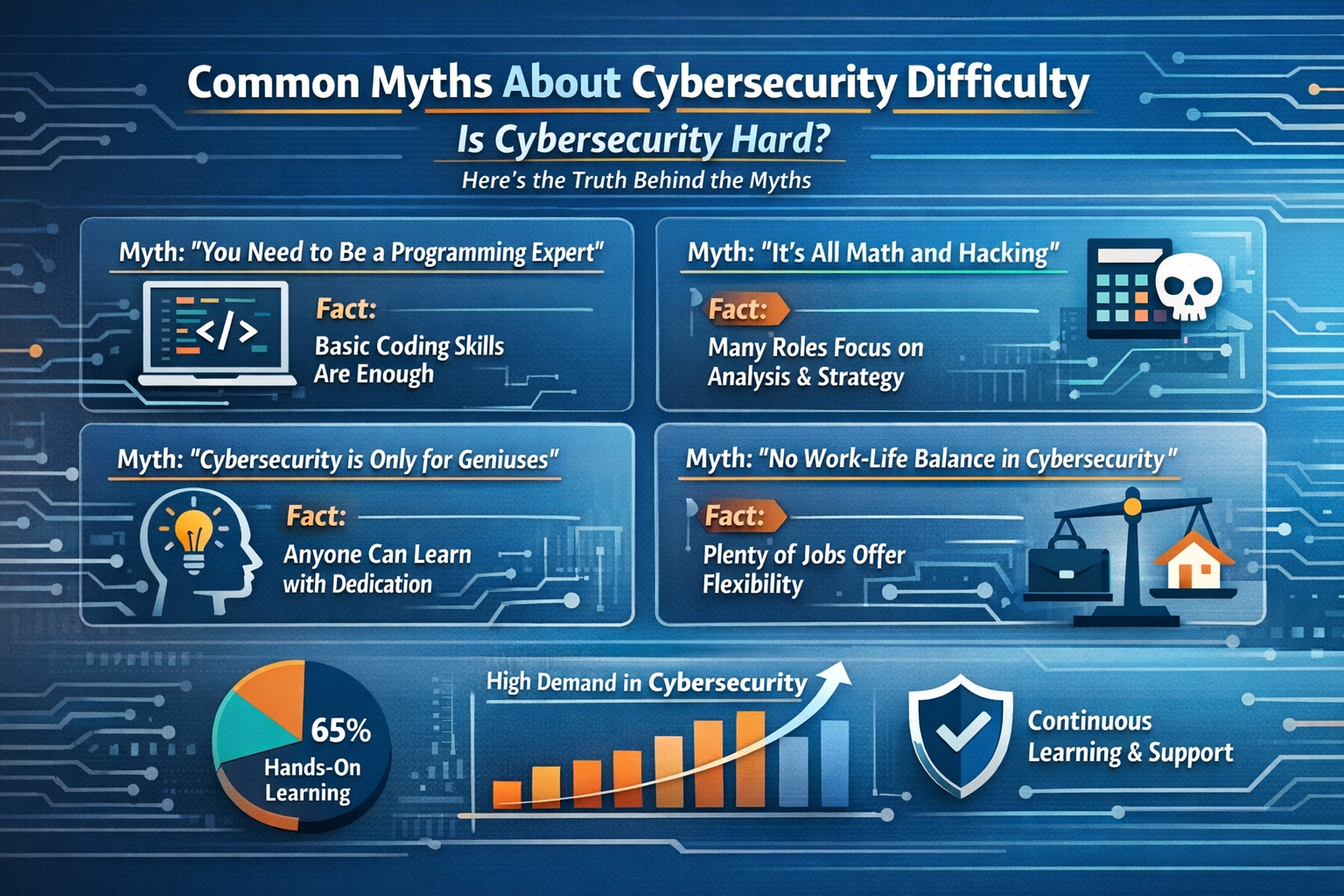
When people ask, “Is cybersecurity hard?”, their minds are often clouded by misconceptions. The media, movies, and sometimes even seasoned professionals unintentionally create an aura of impenetrable complexity around the field. Let’s peel back these layers of myth to reveal the reality that beginners actually encounter.
Myth 1: You Need a Computer Science Degree
One of the biggest blockers for aspiring cybersecurity professionals is the belief that a traditional computer science degree is a mandatory prerequisite. While a CS degree provides a strong theoretical foundation, it is not the only path to success. Many highly skilled cybersecurity experts come from diverse educational backgrounds or none at all. I’ve personally seen successful analysts with degrees in history, philosophy, and even music, who leveraged their strong problem-solving skills and curiosity to pivot into security. What truly matters is a foundational understanding of how computers and networks operate, combined with a thirst for knowledge. Many entry-level roles prioritize practical skills and certifications over a specific degree. For example, a candidate with a CompTIA Security+ certification and hands-on lab experience often holds a strong position.
Myth 2: It’s All Advanced Math and Hacking
Another widespread myth is that cybersecurity revolves solely around complex mathematics, arcane coding languages, and elite-level hacking. While some specialized roles, such as cryptography or malware analysis, do involve advanced concepts, the vast majority of cybersecurity positions focus on more practical applications. Think about securing networks using firewalls, understanding user behaviour to detect anomalies, or enforcing security policies. These tasks require logical thinking, attention to detail, and an understanding of security principles, rather than advanced calculus or reverse engineering every piece of software. Learning to configure a firewall, for instance, is far more about understanding network traffic rules than it is about advanced algorithms. It’s about protecting assets, not just breaking into them. For those interested in strengthening digital defenses, exploring strategies to protect your systems is more common than advanced mathematics 1.
Myth 3: The Field Moves Too Fast
It’s true that the cybersecurity landscape is incredibly dynamic, with new threats emerging constantly. This rapid evolution can make it seem like an impossible task to keep up, leading beginners to ask, “Is cybersecurity hard because it changes so quickly?” However, while specific tools and attack vectors change, the core principles of cybersecurity remain remarkably consistent. Concepts like the CIA triad (Confidentiality, Integrity, Availability), risk management, defense-in-depth, and incident response are timeless. Learning these fundamental principles provides a stable anchor in a sea of change. Once you grasp these basics, adapting to new technologies or threats becomes a process of applying existing knowledge to new contexts, rather than starting from scratch every time.
Myth 4: Only Geniuses Succeed
The image of the “lone wolf hacker genius” often dominates popular culture, creating the impression that only individuals with exceptional intellect can thrive in cybersecurity. This is a damaging myth. While intelligence is certainly helpful, the most successful cybersecurity professionals I’ve encountered possess a combination of curiosity, persistence, and a strong problem-solving mindset. The field often involves meticulous investigation, iterative testing, and learning from mistakes. It’s about being able to methodically break down complex problems, research solutions, and apply them. Anyone with the drive to learn, the patience to troubleshoot, and the resilience to keep going when faced with challenges can succeed, regardless of their perceived “genius” level.
“Cybersecurity isn’t about being the smartest person in the room; it’s about being the most persistent and curious.”
Real Challenges Beginners Face
Even after debunking the myths, it’s important to acknowledge that the journey into cybersecurity isn’t without its genuine hurdles. Beginners will encounter specific challenges that require dedication and strategic navigation. This isn’t to discourage, but to prepare you for what lies ahead. Understanding these challenges upfront can help you mitigate them effectively.
Constant Learning Curve (Threat Evolution)
The most significant challenge beginners face is the perpetual learning curve. The digital threat landscape is a living, breathing entity that evolves daily. New vulnerabilities are discovered, attack techniques become more sophisticated, and defensive technologies advance. This means that formal education or certification is just the starting point; learning truly never stops. For someone new, this can feel overwhelming. Keeping up requires a commitment to continuous education, staying informed about current events, and adapting to new tools and methodologies. Staying informed about cyber threats in 2025 is crucial.
Technical Prerequisites (Networking, OS)
While you don’t necessarily need a CS degree, a solid grasp of fundamental IT concepts is non-negotiable. This includes:
- Networking Basics: Understanding TCP/IP, subnets, routing, firewalls, and common protocols is essential. How data travels across networks forms the backbone of digital security.
- Operating Systems (OS): Proficiency in Windows, Linux, and possibly macOS is critical, as security tools and vulnerabilities often depend on the OS environment. Command-line interfaces are particularly important for Linux.
- Virtualization: Familiarity with virtual machines (VMs) is highly beneficial for setting up labs and testing environments without affecting your main system.
Without these foundational blocks, diving into cybersecurity concepts like intrusion detection or vulnerability assessment can feel like trying to build a house without a foundation.
Soft Skills (Problem-Solving, Ethics)
Beyond technical acumen, soft skills play a massive role. Beginners might underestimate their importance, but they are crucial for success:
- Problem-Solving: Cybersecurity is detective work. You’re constantly analyzing logs, tracing attacks, and figuring out how to fix issues. Strong analytical and problem-solving skills are paramount.
- Critical Thinking: Being able to evaluate information, identify biases, and make informed decisions under pressure is vital, especially during an incident response.
- Communication: You need to clearly explain complex technical issues to non-technical stakeholders, write concise reports, and collaborate effectively with a team.
- Ethics: The power in cybersecurity comes with immense responsibility. Understanding legal and ethical boundaries is not just important; it’s fundamental to maintaining trust and integrity in the profession.
Entry Barriers (No Experience)
The classic “catch-22” of needing experience to get a job, but needing a job to get experience, is a real challenge for beginners. Many entry-level cybersecurity positions still ask for 1-3 years of experience, making it tough to break in. This can be incredibly frustrating. However, this barrier is surmountable through strategic actions like building a strong portfolio, engaging in internships, volunteering, and leveraging certifications that include practical components.
Here’s a table summarizing these challenges and offering mitigation tips:
| Challenge | Beginner Impact | Mitigation Tip |
|---|---|---|
| Constant learning curve | High overwhelm, feeling always behind | Dedicate time daily to industry news (e.g., Krebs on Security blog), subscribe to security newsletters, follow experts on social media. |
| Technical prerequisites | Concepts feel abstract, difficulty applying knowledge | Utilize free resources like Cybrary, Professor Messer, YouTube tutorials for networking and OS fundamentals. Build a home lab. |
| Soft skills development | Overlooked, poor communication, ethical dilemmas | Participate in team projects, practice explaining technical topics, study cybersecurity ethics, engage in critical thinking exercises. |
| Entry barriers (no experience) | Frustration, difficulty landing first role | Pursue certifications with practical labs, create a home lab with personal projects, seek internships, contribute to open-source security projects. |
| Job market competition | Resume screening, feeling unqualified | Google Cybersecurity Certificate, CompTIA Security+, build a strong LinkedIn profile showcasing projects and skills. |
| Burnout from alerts | 24/7 mentality, high stress levels | Practice good work-life balance from the start, learn to prioritize, leverage automation where possible, seek mentorship. |
When considering is cybersecurity hard for non-techies, these challenges are precisely what they will face. However, with the right approach and resources, they can be overcome.
Essential Skills and Knowledge for Starters
To effectively answer “Is cybersecurity hard?” we need to break down the essential skills and knowledge required. It’s not just about what you know, but what you can do. Building a strong foundation is key, like constructing a robust digital fortress.
1. Foundational IT
Before you can secure systems, you must first understand how they work. These are the bedrock skills:
- Networking Fundamentals: This includes knowing the OSI model, TCP/IP protocol suite, common network devices (routers, switches, firewalls), and basic network services (DNS, DHCP). Understanding how data flows is crucial for identifying where attacks can occur and how to defend against them.
- Operating System (OS) Knowledge: Proficiency in Windows and Linux is paramount. This means navigating the file system, managing users and permissions, understanding system processes, and using command-line interfaces (CLI) effectively. Linux, in particular, is a common environment for security tools and servers.
- Programming/Scripting Basics: While not every role requires advanced coding, a basic understanding of scripting languages like Python or PowerShell can be incredibly useful for automation, data analysis, and developing simple security tools. Even understanding the logic behind code helps in identifying vulnerabilities.
- Virtualization: Being able to set up and manage virtual machines (VMs) using tools like VirtualBox or VMware Workstation allows you to create safe environments to test attacks, analyze malware, and practice with security tools without risking your main system.
2. Core Cybersecurity Concepts
Once you have the IT foundation, you can layer on cybersecurity-specific knowledge:
- CIA Triad (Confidentiality, Integrity, Availability): This is the holy grail of information security, representing the three core goals of any security program.
- Confidentiality: Protecting information from unauthorized access (e.g., encryption).
- Integrity: Ensuring information is accurate and untampered (e.g., hashing, digital signatures).
- Availability: Guaranteeing authorized users can access information when needed (e.g., disaster recovery, redundancy).
- Risk Management: Understanding how to identify, assess, and mitigate risks is fundamental. This involves recognizing potential threats, evaluating their likelihood and impact, and implementing controls.
- Threats, Vulnerabilities, and Exploits: Knowing the difference between a threat (potential harm), a vulnerability (weakness), and an exploit (method of leveraging a vulnerability) is critical.
- Access Control: Implementing mechanisms to control who can access what resources (e.g., multi-factor authentication, role-based access control).
- Encryption Basics: Understanding symmetric vs. asymmetric encryption, hashing, and digital certificates is key to securing data in transit and at rest.
- Security Architecture Principles: Learning about defense-in-depth, least privilege, and separation of duties helps in designing robust security systems.
- Incident Response: Knowing the phases of incident response (preparation, identification, containment, eradication, recovery, lessons learned) is crucial for reacting effectively to security breaches. For details on immediate steps, consider these malware removal steps.
3. Practical Tools
Familiarity with various security tools is vital for a beginner. You don’t need to master all of them, but knowing their purpose and basic operation is a strong start:
- Firewalls: Understanding how firewalls filter traffic and enforce security policies (e.g., pfSense, iptables).
- Intrusion Detection/Prevention Systems (IDS/IPS): Tools like Snort or Suricata that monitor network traffic for malicious activity.
- Security Information and Event Management (SIEM) Systems: Platforms like Splunk or ELK Stack (Elasticsearch, Logstash, Kibana) that aggregate and analyze security logs from various sources.
- Vulnerability Scanners: Tools like Nessus or OpenVAS that identify weaknesses in systems and applications.
- Packet Sniffers: Wireshark is invaluable for analyzing network traffic and understanding how protocols work and where anomalies occur.
- Antivirus/Endpoint Detection and Response (EDR): Understanding how these tools protect individual devices.
4. Hands-On Experience
This is arguably the most critical component. Reading about cybersecurity is one thing; actually doing it is another.
- Capture The Flag (CTF) Competitions: Platforms like TryHackMe, Hack The Box, and PicoCTF offer gamified learning environments where you solve security challenges.
- Home Lab: Set up your own virtual lab using VMs. Install different operating systems, practice network configurations, and deploy security tools. Simulate attacks and defenses.
- Personal Projects: Build a secure web application, configure a secure home network, or analyze malware samples in a sandboxed environment.
- Open-Source Contributions: Contributing to open-source security projects or bug bounty programs can provide real-world experience.
How to Get Started: A Beginner’s Roadmap
Feeling overwhelmed by the sheer volume of information? Don’t be. Many people ask, “Is cybersecurity hard to break into without a clear path?” The good news is, there’s a well-trodden roadmap that can guide you from absolute beginner to a confident professional. This isn’t a race; it’s a journey of consistent learning and application.
1. Assess Your Readiness and Interests
Before diving deep, take a moment to understand where you currently stand and what genuinely excites you.
- Self-Assessment: Do you have basic computer literacy? Can you troubleshoot simple IT issues? Are you comfortable with technology? If yes, great! If not, start with basic IT literacy courses.
- Quiz or Aptitude Test: Many online platforms offer free quizzes to gauge your aptitude for cybersecurity. These can help identify your strengths and areas needing improvement. For instance, consider whether you enjoy problem-solving, puzzles, or investigative work.
- Explore Roles: Cybersecurity has many specializations (e.g., Security Analyst, Penetration Tester, Incident Responder, Cloud Security Engineer). Research different career paths in cybersecurity to see what resonates with your interests.
2. Leverage Free and Affordable Resources
You don’t need to spend a fortune to get started. The internet is brimming with high-quality, free, and low-cost learning materials.
- Online Courses (MOOCs): Platforms like Coursera, edX, and Udemy offer introductory cybersecurity courses, often taught by university professors or industry experts. Many have free audit options or financial aid. Google’s Cybersecurity Certificate on Coursera is an excellent example, designed specifically for beginners.
- YouTube Channels: Channels like Professor Messer, The Cyber Mentor, and John Hammond offer free, in-depth tutorials on networking, operating systems, and cybersecurity tools.
- Government and Non-Profit Resources: The National Institute of Standards and Technology (NIST) provides a wealth of frameworks and guidelines. OWASP (Open Web Application Security Project) offers free tools and documentation for web application security.
- Blogs and News Sites: Regularly read industry blogs like Krebs on Security, SANS Internet Storm Center, and CyberTech Journals for updates on threats and best practices. CyberTech Journals itself is a fantastic resource.
- Podcasts: Listen to cybersecurity podcasts during your commute or workouts to stay current with trends and insights.
3. Pursue Industry-Recognized Certifications
Certifications validate your knowledge and skills, making your resume stand out to employers. They provide a structured learning path.
- CompTIA A+ and Network+ (Optional but Recommended): These foundational IT certifications aren’t strictly cybersecurity but provide the essential networking and hardware knowledge that security builds upon.
- CompTIA Security+: This is often considered the gold standard for entry-level cybersecurity professionals. It covers a broad range of core security concepts and is vendor-neutral, making it highly valuable. This is a crucial step for a cybersecurity roadmap in 2025.
- (ISC)² CC (Certified in Cybersecurity): A newer, free certification designed specifically for beginners, offering a great starting point for core concepts.
- CompTIA CySA+ (Cybersecurity Analyst+): After Security+, this certification moves into more advanced topics like threat detection, vulnerability management, and security operations.
- Other Specialized Certs: Depending on your interest, consider certifications from vendors like Microsoft (Azure Security Engineer), AWS (Certified Security – Specialty), or GIAC certifications for more advanced, specific roles.
4. Build Hands-On Experience
This is where theory meets practice, and it’s paramount for overcoming the “no experience” barrier.
- Set Up a Home Lab: This is invaluable. Install Linux distributions (Kali, Ubuntu), Windows Server, a hypervisor (VirtualBox, VMware), and practice with security tools. Simulate attacks and defenses. For example, practice setting up a secure network with a business firewall.
- Practice Platforms: Engage with gamified learning platforms like TryHackMe and Hack The Box. These provide virtual labs and guided exercises to practice skills like penetration testing, digital forensics, and incident response.
- Personal Projects: Document your home lab configurations, create security scripts, analyze network traffic, or build a simple security-focused application. These projects demonstrate initiative and practical skills to potential employers.
- Internships and Volunteering: Look for internships, even unpaid ones, or volunteer for IT/security roles in non-profits. This provides invaluable real-world experience and networking opportunities.
- Bug Bounty Programs: Once you have some foundational skills, participating in bug bounty programs can provide legitimate hacking experience and even financial rewards for finding vulnerabilities in real systems.
By following this roadmap, beginners can systematically acquire the knowledge and experience needed to thrive in cybersecurity, proving that while challenging, the path is certainly navigable.
Success Stories and Motivation
The question, “Is cybersecurity hard?” often comes with an underlying fear of failure. However, countless individuals from diverse backgrounds have successfully transitioned into cybersecurity, proving that dedication and a strategic approach can overcome initial challenges. Their stories serve as powerful motivators.
Story 1: From Non-Tech Background to SOC Analyst in 6 Months
Consider Sarah, a former high school history teacher. She loved problem-solving and critical thinking but had no formal IT background. After feeling a desire for a more dynamic career, she discovered cybersecurity. Sarah started by enrolling in a Google Cybersecurity Certificate program online in early 2025. She dedicated 2-3 hours every evening and weekends to studying networking fundamentals, Linux commands, and core security concepts. She then took the CompTIA Security+ exam, passing it on her first attempt.
During her studies, Sarah actively participated in TryHackMe labs, building a small home lab with virtual machines to practice configuring firewalls and analyzing logs. She leveraged her strong communication skills from teaching to network with professionals on LinkedIn. After just six months of intense self-study and practical application, Sarah landed an entry-level position as a Security Operations Center (SOC) Analyst at a mid-sized company. Her manager was impressed not just by her certifications, but by her demonstrable passion, her problem-solving abilities, and her commitment to continuous learning. Sarah’s journey showcases that a non-technical background is not a barrier when coupled with relentless effort.
Story 2: The Self-Taught Expert Through Certifications and Labs
Mark worked in IT support for years, handling basic desktop issues, but always felt drawn to the more challenging aspects of security. He decided to pursue cybersecurity without going back to college. Mark systematically worked his way through certifications, starting with CompTIA Network+ to solidify his networking knowledge, followed by Security+. He then moved on to CySA+ and even a vendor-specific certification for a popular SIEM tool.
Crucially, Mark didn’t just study for the exams; he spent hundreds of hours building elaborate home labs. He simulated enterprise networks, practiced incident response scenarios, and even contributed to open-source security projects. He became a regular participant in local cybersecurity meetups, learning from others and sharing his knowledge. When he applied for a Cybersecurity Engineer role, his resume, brimming with practical projects, certifications, and a GitHub profile showcasing his scripts, spoke volumes. He proved that extensive self-study and hands-on application could rival a traditional degree.
These stories highlight common themes:
- Persistence: Both Sarah and Mark consistently dedicated time and effort to their goals.
- Practical Experience: Certifications are important, but applying that knowledge in labs and projects is critical.
- Curiosity: A genuine interest in how things work and how they can be broken (and fixed) fuels learning.
“Cybersecurity rewards curiosity and persistence. The field may seem daunting, but every expert started as a beginner, driven by a desire to protect the digital world.”
These examples demonstrate that while the path may be challenging, it’s absolutely achievable. The key is to start, stay curious, and keep building.
FAQ: Is Cybersecurity Hard?
Many aspiring professionals have similar questions about the difficulty of entering and succeeding in cybersecurity. Let’s tackle some of the most common ones.
Q1: Is cybersecurity hard for beginners?
A1: Cybersecurity can be challenging for beginners, primarily due to the vast amount of technical information, the constant evolution of threats, and the need for continuous learning. However, it’s not impossibly hard. With dedication, a structured learning approach, and a willingness to build foundational IT skills (like networking and operating systems), beginners can absolutely succeed. Many free and affordable resources, along with entry-level certifications, are specifically designed to help newcomers navigate the field.
Q2: How hard is it to get into cybersecurity?
A2: Getting into cybersecurity often requires overcoming the “experience gap” – needing experience to get a job. This can make the initial entry point feel hard. However, it’s becoming easier with more beginner-friendly certifications (like Google’s Cybersecurity Certificate or (ISC)² CC), increased availability of online learning platforms, and the high demand for cybersecurity professionals. The difficulty largely depends on your starting point, your commitment to self-study, and your ability to gain practical, hands-on experience through labs, personal projects, or internships. Focusing on practical skills and building a portfolio is key.
Q3: Is cybersecurity worth it for beginners?
A3: Absolutely, cybersecurity is incredibly worth it for beginners in 2025. The demand for skilled cybersecurity professionals continues to outpace supply, leading to excellent job security and competitive salaries. It’s a field that offers diverse career paths, constant intellectual stimulation, and the satisfaction of protecting individuals and organizations from malicious actors. While it requires ongoing learning and problem-solving, the rewards in terms of career growth, impact, and financial stability make it a highly valuable career choice for those willing to invest the effort. Looking at the broader industry, the importance of cybersecurity for businesses highlights the field’s enduring relevance.
Conclusion: Your Next Steps
We’ve covered a lot of ground, from debunking common myths to outlining the real challenges and essential skills. So, is cybersecurity hard? Yes, it presents significant challenges, demanding continuous learning, technical aptitude, and strong soft skills. It’s not a field for the faint of heart or those seeking a static career. However, it is absolutely achievable and incredibly rewarding for anyone with curiosity, persistence, and a strategic approach. The journey may be rigorous, but the destination a secure, impactful, and in-demand career is well worth the effort.
The critical takeaway is that you don’t need to be a genius or have a computer science degree to excel. You need to be methodical, dedicated, and willing to embrace a lifetime of learning. The digital world in 2025 is more interconnected and vulnerable than ever, making the role of cybersecurity professionals more vital than ever.
Your Next Steps:
- Pick One Resource: Don’t try to consume everything at once. Start with a single, highly-rated introductory course, like Google’s Cybersecurity Certificate on Coursera, or dive into Professor Messer’s free CompTIA Security+ videos.
- Start Your Home Lab: Download VirtualBox and install a Linux distribution like Ubuntu or Kali Linux. Begin experimenting with basic commands and network configurations. It’s where theory becomes reality.
- Network and Engage: Join a local cybersecurity meetup or an online community. Ask questions, share your progress, and learn from others.
- Stay Curious: Read industry news, follow security experts, and always be asking “how does that work?” or “how could that be exploited?”
The journey of a thousand miles begins with a single step. Take yours today. The digital defense frontier awaits!











Leave a comment