


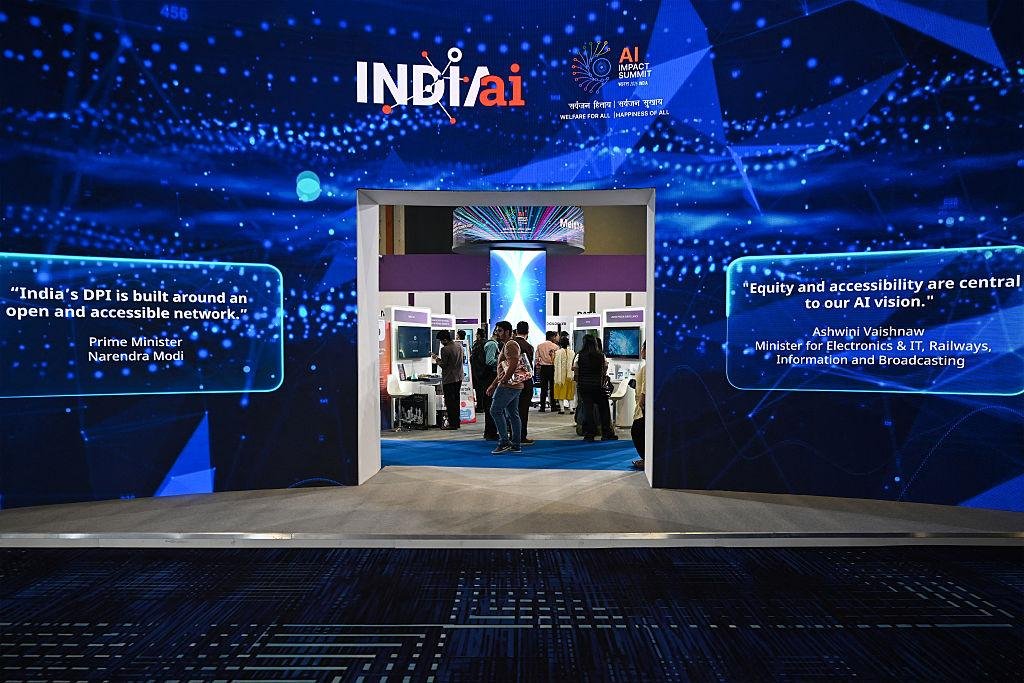
The India AI Impact Summit 2026, currently underway February 16 to 21 2026 at Bharat Mandapam, in New Delhi, represents far more than another tech conference. It marks a fundamental shift in the global AI landscape—one that enterprise leaders worldwide cannot afford to ignore, regardless of where their organizations operate.
When OpenAI CEO Sam Altman, Google CEO Sundar Pichai, and Anthropic CEO Dario Amodei all appear at the same summit, alongside heads of state and global policy makers, the message is clear: India has emerged as a critical battleground for the future of artificial intelligence. But this summit’s significance extends beyond geopolitical positioning—it’s reshaping the practical realities of how enterprises globally will deploy, govern, and scale AI technologies.
With over 35,000 attendees, 300+ exhibitors from 30+ countries, and participation from multilateral organizations including the World Bank and United Nations, the India AI Impact Summit 2026 is setting the agenda for enterprise AI adoption, workforce transformation, and responsible AI governance at a scale unprecedented in previous AI summits.
Table of Contents
Why India’s AI Leadership Moment Matters for Global Enterprises
The India AI Impact Summit 2026 follows the AI Safety Summit at Bletchley Park (2023), AI Seoul Summit (2024), and AI Action Summit in Paris (2025), but with a crucial difference: it’s the first such gathering hosted by a Global South nation and focuses explicitly on measurable impact rather than theoretical safety discussions.
According to analysis from Crowell & Moring, the changing summit titles reflect a broader shift in focus away from AI safety and governance toward practical impact, implementation, and measurable outcomes—precisely the concerns keeping enterprise CIOs and technology leaders awake at night.
India’s Strategic Position in the Global AI Economy
India’s emergence as an AI powerhouse isn’t accidental. The nation offers unique advantages that make it essential to global AI strategy:
Massive talent pool: India’s $283 billion IT sector employs 5.8 million technology professionals, making it the world’s largest reservoir of AI engineering talent. As CNBC reports, not only are tech giants looking to India for engineering talent, but an increasing number of firms are banking on the country for senior leadership roles, with “Chief AI Officer” positions increasingly filled by Indian executives.
Scale market opportunity: With 1.4 billion people and a rapidly digitalizing economy, India represents both a massive market for AI products and services and a testing ground for AI applications at unprecedented scale.
Government commitment: The IndiaAI Mission has committed over $1 billion to bolster compute capacity, foster sovereign AI datasets and frontier models, support AI education, and create frameworks for trustworthy AI.
Global South representation: India’s hosting of this summit signals that AI development and governance will not be dictated solely by Western nations and China, but will incorporate perspectives from developing economies facing different AI implementation challenges.
As Lalit Ahuja, CEO of ANSR, told CNBC: “The summit is a huge validation of the potential of the market. Everyone’s coming in because they realize that this is the place to be in and India just cannot be ignored.”
Three Critical AI Trends Enterprise Leaders Are Watching
While the summit covers dozens of themes across its seven working groups, three trends stand out as particularly critical for enterprise technology strategy:
1. The Agentic AI Revolution: From Tools to Digital Workforces
The most significant shift emerging from discussions at the summit is the transition from generative AI as a productivity tool to agentic AI as autonomous digital workers.
What is Agentic AI?
Unlike generative AI tools that respond to prompts, agentic AI systems can plan, reason, make decisions, and execute multi-step tasks autonomously. Think of the difference between ChatGPT (which answers questions) versus an AI agent that can monitor your supply chain, identify disruptions, evaluate alternatives, place orders with suppliers, and notify relevant stakeholders—all without human intervention.
According to Gartner research, 40% of enterprise applications will be integrated with task-specific AI agents by the end of 2026, up from less than 5% in 2025. Gartner’s best-case scenario projects that agentic AI could drive approximately 30% of enterprise application software revenue by 2035, surpassing $450 billion.
The Workforce Transformation Challenge
Jay Bavisi, Founder and CEO of EC-Council, addressed this transformation head-on at the summit. As reported by The Tribune, India’s IT sector faces a critical inflection point: the same AI technologies dismantling traditional service delivery models are simultaneously creating massive new demand for professionals who can deploy, secure, and govern AI systems at enterprise scale.
The question confronting not just India’s IT sector but global enterprises is whether organizations can retool their workforces fast enough to lead the AI transformation rather than be consumed by it.
Deloitte’s research frames this shift as moving from “AI as a tool” to “AI as a workforce,” requiring organizations to:
- Develop new skills like “agent orchestration”
- Create new roles focused on oversight and strategy
- Implement new incentives aligned to business outcomes rather than intermediate steps
- Build cultures that encourage adoption of human-AI collaboration
According to PwC’s 2026 AI predictions, organizations that successfully navigate this transition will adopt enterprise-wide strategies centered on top-down programs where senior leadership picks specific workflows for focused AI investment, applies dedicated “enterprise muscle” (talent, technical resources, change management), and executes through centralized “AI studios.”
Real-World Enterprise Applications
The summit showcased concrete applications of agentic AI across industries:
- Customer support: Autonomous agents handling 80% of customer queries, reducing resolution time and improving customer satisfaction scores
- Sales operations: Automated sales development representatives (SDRs) researching leads, personalizing outreach, and boosting meeting conversions 4x faster than manual efforts
- Supply chain management: Agents coordinating complex workflows, monitoring disruptions, and executing responses in real-time
- Cybersecurity: Autonomous threat hunting, vulnerability management, and compliance monitoring
- Research and development: Agents managing knowledge bases, coordinating research workflows, and accelerating innovation cycles
According to enterprise deployment statistics, 82% of companies now have AI agents in use, with organizations reporting up to 50% efficiency gains in customer service, sales, and HR operations.
2. Sovereign AI: The New Geopolitical Reality
Perhaps no trend at the summit has more profound implications for enterprise strategy than the emergence of sovereign AI as a critical factor in technology decisions.
Understanding Sovereign AI
Sovereign AI refers to a nation’s capability to produce and deploy artificial intelligence using indigenous computing infrastructure, data, and foundational models. It’s about technology ownership and strategic independence—ensuring that critical AI capabilities aren’t dependent on foreign vendors or subject to geopolitical pressures.
As NVIDIA’s participation in the summit demonstrates, sovereign AI has become central to India’s AI strategy. The country is investing heavily in:
- Domestic AI infrastructure and compute capacity
- Indigenous language models and datasets covering 22 Indic languages
- Locally manufactured AI hardware through “Make in India” initiatives
- Frameworks for data sovereignty and AI governance
Why Enterprise Leaders Should Care
Sovereign AI isn’t just a government concern—it has direct implications for enterprise AI strategy:
Data residency and compliance: Organizations operating across multiple jurisdictions increasingly face requirements to process certain data types using infrastructure located within specific countries. Deloitte’s State of AI in the Enterprise report notes that 58% of companies already use physical AI (robotics, autonomous vehicles) with adoption projected to hit 80% within two years, much of it subject to sovereign AI requirements.
Supply chain resilience: Recent geopolitical tensions have demonstrated the fragility of global technology supply chains. Sovereign AI capabilities provide alternative options when primary providers become unavailable or subject to export restrictions.
Regulatory compliance: Different jurisdictions are implementing AI regulations requiring certain processing to occur within their borders using approved infrastructure. The EU AI Act, for instance, creates compliance requirements that sovereign AI infrastructure can address.
Market access: In some markets, demonstrating use of sovereign AI infrastructure may become a prerequisite for winning government contracts or operating in regulated sectors.
The World Economic Forum analysis notes that governments worldwide are accelerating investments in digital infrastructure—from AI hardware and software to advanced chips and satellite systems—to reduce dependence on foreign vendors. Some governments are providing incentives for sovereign AI, while others are imposing regulatory requirements on locally owned and operated AI infrastructure.
Sarvam.ai’s Sovereign Model Example
A key showcase at the summit is Sarvam.ai, a leader in full-stack sovereign generative AI providing enterprise-grade multimodal models trained for 22 Indic languages. The company is open-sourcing its Sarvam-3 series of large language models, demonstrating how sovereign AI can serve both national interests and enterprise needs.
This privacy-first architecture delivers contextual, production-grade AI for critical business workflows like customer relationship management and finance, ensuring technology sovereignty and enterprise security at global scale.
3. Responsible AI Governance: From Principles to Practice
The third critical theme emerging from the summit is the maturation of responsible AI from aspirational principles to operational requirements.
The Governance Gap
While 60% of executives in PwC’s 2025 Responsible AI survey said that responsible AI boosts ROI and efficiency, nearly half reported that turning RAI principles into operational processes has been a significant challenge.
The summit’s structure around three foundational pillars—People, Planet, and Progress—translates into seven thematic working groups covering:
- AI for economic growth and social good
- Democratizing AI resources
- Inclusion for social empowerment
- Safe and trusted AI
- Human capital development
- Science and research
- Resilience, innovation, and efficiency
Criticism and Accountability
The summit has not been without criticism. TechPolicy.Press analysis argued that the summit’s structure granted “multinational corporations parity with sovereign governments” through the CEO Roundtable and Leaders’ Plenary, while providing no equivalent high-level platform for civil society, labor leaders, or human rights defenders.
The controversy over Galgotias University presenting a Chinese-manufactured robot dog as indigenous development, and the subsequent requirement to vacate their exhibition stall, underscores the accountability challenges in AI governance.
Practical Governance Frameworks
Despite these challenges, the summit is advancing practical governance frameworks enterprise leaders can implement:
Multi-layered risk assessment: EY’s participation at the summit highlighted “The 360° AI Stack: Scaling Intelligence through Infrastructure, Investment, and Integrity”—emphasizing the need to synchronize funding, regulation, and engineering for durable, enterprise-grade AI scaling.
Human-AI collaboration models: Rather than viewing AI governance as primarily a risk mitigation exercise, leading organizations are building governance into performance rubrics so that as AI handles more tasks, humans take on active oversight roles.
Agentic AI governance: Forrester’s predictions indicate that half of enterprise ERP vendors will launch autonomous governance modules combining explainable AI, automated audit trails, and real-time compliance monitoring.
According to Deloitte’s research, only one in five companies has a mature model for governance of autonomous AI agents, despite agentic AI usage poised to rise sharply. Enterprises where senior leadership actively shapes AI governance achieve significantly greater business value than those delegating the work to technical teams alone.
Strategic Implications for Enterprise Leaders
The convergence of these trends at the India AI Impact Summit 2026 creates specific strategic imperatives for enterprise technology leaders:
1. Shift From AI Pilots to Enterprise-Scale Deployment
The era of AI experimentation is ending. As Bernard Marr notes, GenAI is moving rapidly from enterprise pilots to operational adoption, transforming knowledge workflows across software engineering, legal teams, and project management.
Organizations must transition from scattered pilot projects to enterprise-wide AI strategies with:
- Centralized AI studios or centers of excellence
- Standardized deployment frameworks and governance models
- Clear ROI metrics and business outcome tracking
- Integration with existing enterprise systems and workflows
According to PwC research, only one-third of organizations are using AI to deeply transform—creating new products and services or reinventing core processes. The remaining two-thirds are using AI at surface level with little process change. Only the first group is truly reimagining their businesses rather than optimizing existing operations.
2. Prepare for the Orchestrated Workforce Model
The shift to agentic AI requires fundamentally rethinking workforce planning and organizational design.
Immediate actions:
- Audit current processes: Identify workflows with clear success metrics, well-defined decision criteria, and sufficient volume to justify automation investment
- Develop agent orchestration capabilities: Build teams capable of managing hybrid human-AI workforces
- Redesign roles and incentives: Align compensation and performance metrics to business outcomes rather than activity-based measures
- Invest in reskilling programs: Focus on skills that complement AI capabilities—strategic thinking, complex problem-solving, ethical judgment
Salesmate’s analysis of AI agent trends notes that a new role—”AI workforce manager”—is emerging with responsibilities including:
- Task orchestration between human employees and AI agents
- Agent governance ensuring operation within policies and compliance requirements
- Performance optimization through monitoring and fine-tuning
- Cross-system coordination aligning agents across CRM, ERP, support, and analytics platforms
Long-term transformation:
Organizations should follow Ethan Mollick’s (Wharton School) guidance that the transition isn’t about replacing humans with machines, but creating new forms of human-AI collaboration that leverage the unique strengths of both human and silicon-based workers.
3. Develop Multi-Cloud and Sovereign AI Strategies
The rise of sovereign AI requirements means enterprises can no longer rely on single-cloud strategies or assume unrestricted access to global AI infrastructure.
Strategic considerations:
- Assess data sovereignty requirements: Map which data types and processing activities are subject to local jurisdiction requirements
- Evaluate sovereign AI infrastructure options: Understand capabilities and limitations of emerging sovereign AI platforms in key markets
- Build flexible architecture: Design systems that can operate across multiple infrastructure providers and comply with varying regulatory requirements
- Monitor geopolitical risks: Track how AI is becoming part of broader technology competition between nations
4. Implement Practical Responsible AI Frameworks
Moving from responsible AI principles to operational practice requires concrete implementation:
Governance structures:
- Establish executive-level AI ethics boards with clear decision-making authority
- Create operational teams responsible for translating principles into technical requirements
- Implement automated governance tools for continuous monitoring and compliance
Technical controls:
- Deploy explainable AI systems that can articulate decision rationale
- Implement automated audit trails documenting AI decisions and actions
- Build testing frameworks for bias detection and mitigation
- Establish multi-agent verification where different AI systems check each other’s work
Transparency and accountability:
- Document AI system capabilities, limitations, and failure modes
- Create clear escalation paths when AI systems encounter edge cases
- Maintain human oversight for high-stakes decisions
- Communicate AI use to affected stakeholders
5. Focus on Measurable Business Outcomes
The shift from “AI Safety Summit” to “AI Impact Summit” reflects growing pressure to demonstrate tangible business value from AI investments.
EY’s AIdea of India: Outlook 2026 report examines how enterprises measure ROI across:
- Time savings and productivity gains
- Cost reduction and operational efficiency
- Revenue growth and new business models
- Strategic differentiation and competitive advantage
Organizations should establish clear metrics before deploying AI systems and track both intended outcomes and unintended consequences.
The India Opportunity: Beyond the Summit
While the summit itself is a six-day event, its implications extend far beyond. India is positioning itself not just as a market for AI consumption but as a source of AI innovation, talent, and sovereign capabilities.
The $18 Billion Semiconductor Bet
As CNBC reports, India has approved $18 billion worth of semiconductor projects as it looks to build a domestic supply chain—directly addressing a critical bottleneck in AI infrastructure deployment.
The Startup Ecosystem
With over 4,000 Indian AI startups already part of the NVIDIA Inception program, and prominent venture capital firms including Peak XV, Elevation Capital, Nexus Venture Partners, and Accel India partnering to identify and fund promising AI startups, India is building a comprehensive AI innovation ecosystem.
The summit’s three flagship global challenges—AI for All, AI by HER, and YUVAi Global Youth Challenge—received over 4,650 applications from more than 60 countries, showcasing solutions ranging from AI-driven infection screening and climate risk analytics to precision nutrition platforms and cervical cancer screening devices.
The Global Capability Center Evolution
India’s Global Capability Centers (GCCs) are evolving from cost centers to innovation hubs. According to EY’s analysis, these centers are increasingly driving AI adoption, digital transformation, and enterprise strategy for their parent organizations.
Key Takeaways for Enterprise Leaders
As the India AI Impact Summit 2026 continues to unfold, several clear messages emerge for enterprise technology leaders:
- AI is transitioning from tool to workforce: Organizations must prepare for agentic AI systems that can autonomously execute complex multi-step tasks, requiring new governance models, workforce strategies, and operational frameworks.
- Sovereign AI is reshaping technology strategy: Data sovereignty, regulatory compliance, and geopolitical considerations are making sovereign AI capabilities essential components of enterprise technology strategy.
- Responsible AI requires operational maturity: The gap between AI ethics principles and operational practice must close through concrete governance structures, technical controls, and accountability mechanisms.
- India has emerged as a critical AI hub: Whether for talent access, market opportunity, or sovereign AI capabilities, India is no longer optional in global AI strategy.
- Speed of transformation is accelerating: With 40% of enterprise apps expected to integrate AI agents by end of 2026 (per Gartner), the window for strategic positioning is narrow.
- Human-AI collaboration is the goal: Success won’t come from AI replacing humans or humans resisting AI, but from creating new forms of collaboration that leverage the unique strengths of both.
The organizations that internalize these lessons and act decisively will define the next era of enterprise technology. Those that don’t risk being defined by it.







Leave a comment