



Entry Level Cybersecurity Roles rarely resemble the fast-paced hacking scenes shown in movies. On the first day, the work is far more focused on careful monitoring, accurate documentation, and continuous learning. Even Security+ certified and resume-ready hires quickly realize that real-world cybersecurity depends on consistency, discipline, and attention to detail rather than dramatic technical exploits.
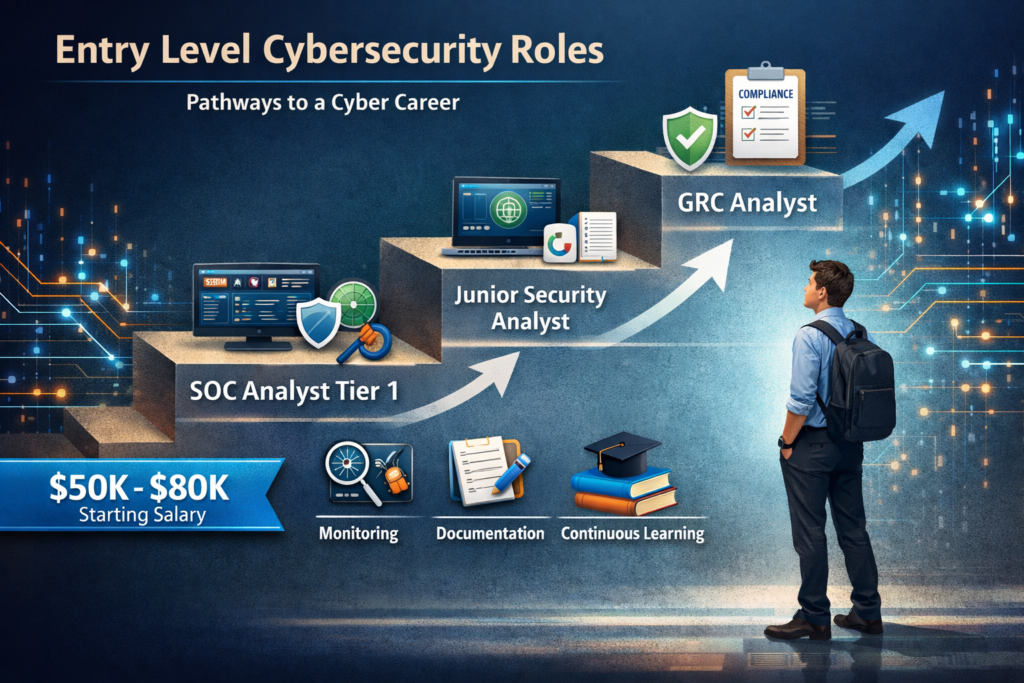
In practice, entry-level roles center on understanding systems, following established processes, and learning how threats unfold over time. While the global talent shortage has made Entry Level Cybersecurity Roles more accessible, newcomers are often surprised by the day-to-day reality of reviewing alerts, documenting findings, and building trust within the team. This guide breaks down what to expect across common paths such as SOC Analyst, Junior Security Analyst, and GRC Analyst, including realistic workload expectations and typical starting salaries in the $50,000 to $80,000 range.
Table of Contents
Key Takeaways:
- Reality Check: Most entry level cybersecurity roles focus on foundational tasks like monitoring, documentation, and adhering to established processes, not immediate high-stakes incident response.
- Diverse Paths: Common entry points include SOC (Security Operations Center) Analyst, Junior Security Analyst (generalist), and GRC (Governance, Risk, and Compliance) Analyst, each offering unique daily experiences.
- Essential Skills: Beyond technical basics like TCP/IP and the CIA triad, critical soft skills include attention to detail, clear communication, documentation, and a strong willingness to learn.
- Competitive Pay: Starting salaries for entry level cybersecurity jobs typically range from $50K-$80K, with potential for higher compensation in major cities or specialized industries.
- Strategic Preparation: Success hinges on certifications (Security+), hands-on lab experience, and persistent job searching, often involving numerous applications and interviews.
I. Reality vs. Hollywood
Breaking the Myth
When envisioning entry level cybersecurity roles, many aspiring professionals picture themselves as digital superheroes, thwarting advanced persistent threats with a flurry of keystrokes. The truth, however, is far less cinematic but infinitely more important. Your first cybersecurity job will primarily involve monitoring systems for anomalies, meticulously documenting findings, and diligently following established security processes. This foundational work is absolutely essential for any organization’s security posture. It’s about building the necessary skills and understanding the landscape before tackling the more dramatic, high-level challenges.
What “Entry-Level” Means
For entry level cybersecurity roles, employers generally look for candidates with 0-2 years of relevant experience, though prior IT experience can be a significant advantage. Education requirements often include a degree (any field can work, especially if combined with relevant training), a foundational certification like CompTIA Security+, or demonstrable hands-on projects and lab work. It’s important to set realistic expectations: you won’t be leading incident response efforts or architecting complex security solutions on day one.
Common Entry Points
The most frequent gateways into the cybersecurity field for new professionals include:
- SOC Analyst (Tier 1): This is arguably the most common starting point.
- Junior Security Analyst: A broader, more generalist role.
- GRC Analyst: Focused on compliance and risk management, often less technical.
These roles represent the core of breaking into cybersecurity.
II. SOC Analyst (Tier 1) – Day in the Life
A. Role Overview
The SOC Analyst (Tier 1) is one of the most common entry level cybersecurity roles. Your primary mission: monitor security alerts, triage potential incidents, and escalate genuine threats.
B. Typical Shift Scenario
Imagine starting a Monday morning as a Tier 1 SOC Analyst at a mid-sized financial institution.
8:00 AM – Shift Start
You clock in, grab your coffee, and settle into your workstation. The first order of business is to review the handover notes from the night shift. Your colleague reports that three incidents are still ongoing, requiring follow-up, and the SIEM (Security Information and Event Management) system has generated 47 new alerts overnight. The feeling is a mix of anticipation and a slight dread of the unknown.
8:30 AM – Alert #1: “Failed logins – jsmith” ⚠️
Your SIEM dashboard flashes with a high-priority alert: “Excessive Failed Logins” for a user named ‘jsmith’.
You begin your investigation:
- Check times and IPs: The attempts came from a local office IP address during business hours.
- Account Status: You verify jsmith’s account is not locked out, nor is it flagged as compromised.
- Context: A quick check of your internal communication channels (Slack/Teams) reveals a recent announcement about a mandatory password reset due to a forgotten password issue.
- Result: It’s a user who simply couldn’t remember their new password after a weekend. This is a classic FALSE POSITIVE.
- Action: You document your findings thoroughly, categorize the alert, and close it out.
9:15 AM – Alert #2: “Suspicious traffic – FINANCE-WKS-042”
Another critical alert pings: “Unusual Outbound Connection” from an endpoint named ‘FINANCE-WKS-042’ to a known suspicious IP address. This feels different.
- IP Reputation: A quick lookup reveals the destination IP is listed as a known Malicious Command and Control (C2) server [1]. This immediately raises a red flag.
- Endpoint Activity: You pivot to the Endpoint Detection and Response (EDR) tool. It shows unusual PowerShell execution on FINANCE-WKS-042, attempting to communicate with the suspicious IP.
- User Identification: Cross-referencing the endpoint, you find it belongs to the CFO’s assistant.
- Action: Following the documented incident response plan, you immediately isolate the endpoint from the network to prevent further communication or lateral movement. You then escalate the incident to the Tier 2 SOC Analyst with all your documented findings, screenshots, and actions taken.
- Outcome: Due to your swift actions, a potential ransomware attack was stopped before it could encrypt critical financial data. A small victory, but a significant one.
10:00 AM-3:30 PM – The Reality
The rest of your shift is a mix of routine and the occasional spike of adrenaline. You process another 15+ alerts, finding that roughly 80% are, again, false positives. You spend time tuning SIEM rules to reduce noise, update outdated security procedures based on a recent audit recommendation, and collaborate with Tier 2 analysts on ongoing investigations. It’s a constant cycle of vigilance, analysis, and documentation.
3:30 PM – Handover
As your shift nears its end, you meticulously document all your activities, any pending investigations, and relevant observations. You then brief the incoming SOC Analyst, ensuring a smooth transition.
C. The Real Deal
Challenges: Working in an entry level cybersecurity role as a SOC Analyst comes with its unique set of difficulties. You’ll face significant alert fatigue from the 80-90% false positives, the demanding nature of 24/7 shift work (which often includes nights, weekends, and holidays), the repetitive tasks that can feel monotonous, and the inevitable struggle with imposter syndrome as you navigate complex threats.
Benefits: Despite the challenges, the demand for SOC Analysts is incredibly high, offering excellent job security. There’s a clear career path from Tier 1 to Tier 2 and eventually Tier 3, providing a tangible progression. You gain invaluable hands-on learning with critical security tools and benefit from the constant team support in a collaborative environment.
Success Timeline:
- First 30 days: You’ll be learning to navigate the SIEM, understanding basic alert types, and likely handling 20+ alerts solo with supervision.
- Within 6 months: You should achieve 90%+ accuracy in triaging alerts, be able to perform basic incident response steps, and contribute actively to investigations.
- Within 1 year: You’ll be a proficient Tier 1 analyst, likely ready for promotion to Tier 2 or eager for more advanced entry level cybersecurity roles.
D. Skills & Pay
Daily Tools: Proficiency or familiarity with SIEM platforms (like Splunk, Microsoft Sentinel, or QRadar), ticketing systems (ServiceNow, Jira), foundational TCP/IP networking knowledge, and strong documentation skills are crucial.
Salary:
- Starting: $50,000 – $70,000
- 1-2 years experience: $65,000 – $85,000
- Top metropolitan areas: Can reach $70,000 – $90,000
- Night shift differential: Often adds an extra 10-20% to base pay.
III. Junior Security Analyst – The Generalist
A. Role Overview
A Junior Security Analyst occupies a broader entry level cybersecurity role, often covering vulnerability management, user security support, and assisting with various security tools. This role typically adheres to a more traditional 9-5 schedule.
B. Day Highlights
Let’s look at a typical day for a Junior Security Analyst working for a growing tech startup.
9:00 AM – Vulnerability Scan Review
Your day kicks off by reviewing the results of last night’s automated vulnerability scan. The report indicates 247 vulnerabilities across 150 servers. Among them, a critical Exchange CVE (Common Vulnerabilities and Exposures) stands out [2]. Your task is to research this vulnerability, understand its impact, coordinate with the server administration team to schedule the patch, and then meticulously track its remediation until completion.
11:00 AM – User Support & Onboarding
A new employee just joined the engineering team. Your job is to configure their VPN access, ensuring they can securely connect to company resources. You also enable Multi-Factor Authentication (MFA) on all their accounts, test the setup, and document the process for future reference.
1:00 PM – Phishing Campaign Launch
It’s time for the monthly simulated phishing campaign. You upload a list of target users, select and configure new phishing email templates designed to test their awareness, and schedule the campaign to launch the following morning. You’ll track the click-through rates and report on them later.
2:00 PM – Access Review
You’re tasked with performing an access review for the HR department. You pull reports of 50 HR accounts, meticulously checking their permissions against documented roles. You flag 5 accounts with excessive permissions—for instance, an HR generalist having administrative access to the payroll system—and create tickets to reduce their privileges to the principle of least privilege.
3:00 PM – Incident Support
A user reports a suspicious email they received. They forwarded it to the security alias, as per company policy. You guide them on safe handling procedures (e.g., “do not click any links, do not download attachments”) and update the internal wiki with an FAQ section on identifying and reporting phishing attempts.
4:00 PM – Learning & Development
The last hour of your day is dedicated to continuous learning. Today, you tackle a new module on TryHackMe focused on web application vulnerabilities and practice using Nessus, a popular vulnerability scanner, in your home lab environment.
C. Reality & Pay
Pros: This role offers incredibly diverse tasks, providing broad exposure to different areas of cybersecurity. The typical 9-5 hours offer better work-life balance compared to SOC shifts. You’ll build strong relationships across departments and get hands-on with a variety of security tools.
Cons: You might find yourself waiting on approvals from other teams to implement security changes, dealing with occasional user resistance to security policies, and sometimes bogged down by administrative work.
Salary: Starting salaries for Junior Security Analysts typically range from $55,000 – $75,000.
IV. GRC Analyst – The Compliance Path
A. Role Overview
The GRC (Governance, Risk, and Compliance) Analyst is another excellent entry level cybersecurity role for those who prefer less technical work. This position focuses on policies, audits, and ensuring adherence to regulations. It’s often an ideal path for career changers.
B. Audit Day Snapshot
Imagine an eventful day for an Entry Level GRC Analyst during an external SOC 2 audit at a healthcare technology company.
9:00 AM – Audit Evidence Collection
The first task of the day is critical: gathering evidence for the auditors. You pull quarterly access logs from the Identity and Access Management (IAM) system, collect change management tickets from the IT service desk, and compile training completion records for mandatory security awareness training for all employees.
9:30 AM – Evidence Preparation & Review
You begin preparing the collected evidence. This involves exporting IAM reports, cross-referencing them to verify that all access changes had proper approvals, and carefully redacting any sensitive personal data to maintain privacy. Precision is key here.
11:00 AM – Policy Review
With the audit evidence sorted, you turn your attention to internal documentation. While reviewing the company’s Incident Response Policy, you spot an outdated procedure for data breach notification that no longer aligns with current state regulations. You immediately create a ticket to update the policy and notify the relevant stakeholders.
1:00 PM – Control Testing
Auditors need to see proof that controls are effective. You’re assigned to test firewall change management. You review 20 recent firewall change requests, comparing them against the documented approval process. You discover two instances where changes were implemented without the required multi-level approval, documenting these deviations as findings for the audit.
2:30 PM – Vendor Risk Assessment
A new cloud vendor is being considered for patient data storage. You review their security documentation, looking for evidence of their compliance with HIPAA and other healthcare regulations. You flag a critical missing requirement: the vendor does not enforce MFA for administrative access to their platform, presenting a significant risk.
3:30 PM – Training Compliance Metrics
You check the metrics for the annual security awareness training. The current completion rate is 94%, just shy of the 95% target. You generate a list of the 15 overdue employees and send out personalized reminders, explaining the importance of compliance.
4:30 PM – Updates & Reporting
You spend the last part of your day updating the risk register with the new vendor finding, updating the control tracker based on your testing results, and contributing to the daily audit dashboard, ensuring all progress is transparent.
C. Reality & Pay
Pros: GRC roles offer a generally 9-5 schedule and often boast a better work-life balance. You gain a holistic view of an organization’s security posture and its legal obligations, making it less technical but highly strategic.
Cons: The job can involve significant audit stress during compliance periods. Some tasks can be perceived as merely “checkbox” activities, and there’s often repetitive documentation work.
Salary: Starting salaries for GRC Analysts typically range from $55,000 – $75,000.
V. Quick Comparison
Choosing the right among the entry level cybersecurity roles depends on your personality, technical aptitude, and career aspirations. Here’s a quick comparison to help you decide:
Which Role Fits You?
| Factor | SOC Analyst (Tier 1) | Junior Security Analyst | GRC Analyst |
|---|---|---|---|
| Technical | Medium (tools, networking, incident triage) | Medium (vulnerability scanning, tool configuration) | Low-Medium (policy review, evidence gathering) |
| Hours | Predominantly 24/7 shifts (nights, weekends) | Standard 9-5 | Standard 9-5 |
| Stress | High (fast-paced, critical alerts, alert fatigue) | Medium (diverse tasks, user issues, deadlines) | Medium (audit pressures, compliance deadlines) |
| Learning | Deep dive into SIEM, EDR, network traffic analysis | Broad exposure to various security domains | Regulatory frameworks, risk methodologies |
Choose SOC Analyst: If you thrive under pressure, enjoy hands-on technical work, and are comfortable with shift schedules, this is an excellent starting point. You’ll be on the front lines, directly responding to threats.
Choose Junior Security Analyst: If you prefer variety in your tasks, want a traditional 9-5 schedule, and enjoy collaborating with different teams while gaining broad security exposure, this role is a great fit.
Choose GRC Analyst: If you are detail-oriented, value work-life balance, have a keen interest in policies and regulations, and prefer less hands-on technical work, the GRC path will suit you best.
VI. Universal Expectations

Regardless of the specific entry level cybersecurity roles you pursue, certain expectations are universal for employers.
What Employers Want
Technical Skills (Foundational):
- TCP/IP Basics: Understanding how networks communicate is non-negotiable.
- CIA Triad: Confidentiality, Integrity, and Availability, the pillars of cybersecurity.
- Security+ Certification: Often a baseline requirement or a strong differentiator.
- Willingness to Learn Tools: Cybersecurity is tool-heavy; showing you can quickly adapt to new platforms is key.
Soft Skills (Critical for Success):
- Attention to Detail: Missing a small detail can have massive consequences.
- Communication: Clearly explaining technical issues to non-technical stakeholders, and documenting findings.
- Documentation: Thorough, clear, and concise note-taking and procedure writing.
- Following SOPs: Adhering to Standard Operating Procedures is paramount in security.
- Asking Questions: Don’t be afraid to ask for clarification, it’s better than making a mistake.
Attitude:
- Humble: You don’t know everything, and that’s okay. Be open to feedback.
- Curious: A genuine desire to understand ‘how’ and ‘why’ things work (or break).
- Persistent: Security challenges can be complex and frustrating; stick with it.
- Team-Player: Cybersecurity is a team sport. Collaboration is essential.
First 90 Days
Your first three months in any entry level cybersecurity role will be a whirlwind of learning and adaptation.
- Week 1-2 (Overwhelming): Expect to feel completely swamped. You’ll be introduced to numerous new tools, shadowing colleagues, and trying to absorb vast amounts of company-specific documentation, processes, and jargon. Don’t worry, this is normal!
- Week 3-8 (Building Confidence): You’ll start to take on simpler tasks independently, make fewer errors, and begin to feel more confident in your understanding of the daily workflows. You’ll be actively contributing, albeit under close supervision.
- Week 9-12 (Finding Rhythm): By the end of your first quarter, you should be feeling more comfortable in your role, contributing meaningfully to the team, and starting to tackle more complex tasks with increasing autonomy.
VII. Salary Breakdown
Understanding the compensation landscape is a key part of exploring entry level cybersecurity roles. While salaries vary, here’s a general overview for 2026.
Compensation Overview
By Role (Average Starting Base Salary):
- SOC Analyst (Tier 1): $50,000 – $70,000
- Junior Security Analyst: $55,000 – $75,000
- GRC Analyst: $55,000 – $75,000
Location Impact:
- Tier 1 cities (e.g., San Francisco, New York, Washington D.C.): Expect salaries to be 30-50% higher than the national average due to higher cost of living and demand.
- Tier 2 cities (e.g., Dallas, Atlanta, Denver): Salaries typically 15-25% higher.
Industry Impact:
- Finance/Banking: Often pays 20-30% more due to stringent regulatory requirements and high-value assets.
- Tech/Software: Generally 15-25% higher, with potential for equity.
- Government/Defense: Can be slightly lower but offers excellent benefits and job stability.
Additional Compensation & Benefits:
- Certification Reimbursement: Many companies offer $1,000-$5,000 per year for professional development and exam fees.
- Shift Differential: SOC roles with night or weekend shifts often include an additional 10-20% pay.
- Performance Bonuses: 5-10% of base salary is common.
- Sign-on Bonuses: Sometimes offered for competitive roles, ranging from $2,000-$5,000.
These figures represent a strong starting point for entry level cybersecurity roles, reflecting the high demand in the industry.
VIII. Getting Started
Breaking into entry level cybersecurity roles requires strategic preparation and a persistent job search.
Before Job Hunting
Certifications (Your Foot in the Door):
- CompTIA Security+: This is widely considered the must-have baseline certification for entry-level positions. It validates your core security knowledge.
- CompTIA CySA+: A strong bonus if you can obtain it, demonstrating more advanced analytical skills.
Home Lab (Practical Experience):
- Virtualization: Set up VirtualBox or VMware Workstation.
- Operating Systems: Install Windows and Linux VMs (e.g., Kali Linux, Ubuntu Server).
- Security Tools: Deploy Splunk Free or ELK Stack for log analysis, practice with vulnerability scanners like Nessus or OpenVAS.
- Documentation: Document everything you do in your lab. This proves practical skills. Consider writing blog posts about your lab experiences or creating a GitHub repository to showcase your setup and findings.
Practice Platforms (Hands-on Learning):
- TryHackMe: Focus on learning paths like “SOC Level 1” or “Jr. Penetration Tester.” These offer guided, practical exercises.
- HackTheBox/VulnHub: For more challenging, self-directed penetration testing practice.
- LetsDefend.io: Simulates a SOC environment, allowing you to practice incident response scenarios.
Online Presence (Professional Branding):
- LinkedIn Optimization: Ensure your profile highlights your skills, certifications, and any projects. Connect with industry professionals.
- GitHub Showcase: Host your lab documentation, scripts, or project code.
- Personal Blog: Share your learning journey, lab setups, or insights into security topics.
Job Search
Where to Look:
- Job Boards: LinkedIn Jobs, Indeed, Dice, CyberSecurityJobsite.com – use keywords like “entry-level,” “junior,” “associate.”
- Company Sites: Many organizations post roles directly.
- Managed Security Service Providers (MSSPs): Often have high turnover and a constant need for entry-level analysts.
- USAJOBS: For government positions, which can offer excellent stability and benefits.
Reality of the Search: Be prepared for a marathon, not a sprint. It’s common to submit 50-100 applications and for the search to take 2-6 months. Many rejections are part of the process.
Tips for Success:
- Tailor Your Resume: Customize your resume for each job description.
- Highlight Certs & Projects: Put your Security+ and any significant lab projects front and center.
- Quantify Achievements: Instead of “Used TryHackMe,” write “Completed 50+ TryHackMe rooms, gaining practical experience in network analysis and vulnerability exploitation.”
IX. Interview Essentials
Once you land an interview for entry level cybersecurity roles, knowing what to expect can significantly boost your confidence and performance.
Common Questions
Interviewers will typically combine technical and behavioral questions to assess your fit.
Technical Questions (Sample):
- “Can you explain the TCP 3-way handshake?”
- “What’s the difference between TCP and UDP?”
- “Describe the CIA triad and why it’s important in cybersecurity.”
- “If you see an alert for 50 failed login attempts for a single user account, what would be your first steps to investigate?” (This is a common SOC analyst question).
- “What is a phishing attack? How would you identify one?”
Behavioral Questions (Sample):
- “Tell me about a time you had to learn something new quickly.”
- “Describe a mistake you made and what you learned from it.”
- “How do you prioritize tasks when everything seems urgent?”
- “Why are you interested in cybersecurity?” (Show passion and a genuine interest beyond just salary).
- “Tell me about a time you had to deal with a difficult user or colleague.”
Your Turn (Questions to Ask):
Always have questions prepared to ask the interviewer. This shows engagement and genuine interest.
- “What does a typical day look like for someone in this role?”
- “What tools and technologies does your team primarily use?”
- “What opportunities are there for training and professional development?”
- “What does the career path look like for someone starting in this position?”
Tips for Success:
- STAR Method: Use the Situation, Task, Action, Result (STAR) method for behavioral questions.
- Honesty about Limits: It’s okay to say, “I don’t know the exact answer, but based on my understanding of [related concept], I would approach it by [logical steps] and then research further.” This shows critical thinking.
- Show Enthusiasm: Your passion for cybersecurity and a strong willingness to learn can often outweigh a lack of specific experience.
X. Conclusion
Breaking into entry level cybersecurity roles is an exciting, attainable goal in 2026. While the reality of these positions might not mirror Hollywood’s dramatic portrayals, they are unequivocally foundational and essential to global digital defense. Whether you gravitate towards the front-line vigilance of a SOC Analyst, the broad scope of a Junior Security Analyst, or the regulatory focus of a GRC Analyst, there’s a pathway for diverse strengths and interests. Success in these roles, more than just technical aptitude, hinges on your attitude: attention to detail, relentless curiosity, unwavering persistence, and a collaborative spirit.
Your Action Plan
Don’t wait for the perfect moment. Take concrete steps to launch your cybersecurity career:
- This Week: Choose one of the entry-level paths that most resonates with you. Begin studying for your CompTIA Security+ certification. Join online communities like r/cybersecurity on Reddit for insights and networking.
- This Month: Complete at least 10 modules on TryHackMe, focusing on relevant introductory topics. Optimize your LinkedIn profile, showcasing your learning journey and aspirations.
- This Quarter: Aim to earn your Security+ certification. Start building out your home lab environment. Begin applying to 20-30 entry level cybersecurity roles, tailoring your resume for each.
Your first role is not just a job; it’s the launchpad for a dynamic, rewarding career. Take that first step, walk through the door, and secure your future in cybersecurity.











Leave a comment