


In what may well be one of the most consequential regulatory shifts in recent Indian tech history, the Digital Personal Data Protection (DPDP) Act, 2023 is proving to be a wake-up call for technology leaders. With maximum fines soaring to ₹250 crore, the stakes have moved from compliant checkboxes to boardroom urgency.
This law isn’t just another data policy — it fundamentally reorients how organizations must think about user data, cyber risk, and trust in India’s digital economy.
What the DPDP Act 2023 Really Is
In August 2023, India introduced the Digital Personal Data Protection (DPDP) Act, marking its first major attempt at a wide-ranging legal framework for digital personal data. The law’s core objective: to empower data principals (citizens) with control over how their data is collected, processed, stored, and shared.
At the same time, the Act defines obligations for data fiduciaries, meaning any business or government body that handles personal data. Key to its enforcement is the Data Protection Board of India, a new regulatory body given the power to investigate complaints, direct corrective action, and impose penalties.
What makes the DPDP Act especially powerful is not just the rights it grants to individuals — it’s the burden it places on companies to build privacy and security into their operations from the ground up.
Why ₹250 Crore Matters — A Real Threat for CISOs and Tech Leaders
The punitive structure of the Act is seismic. By making the cost of non-compliance potentially hundreds of crores, the DPDP Act transforms data management into a strategic risk rather than a purely legal one.
Here’s a breakdown of key penalties:
- ₹250 crore: For failing to deploy “reasonable security safeguards” that lead to personal data breaches.
- ₹200 crore: For failing to notify both the Data Protection Board and affected data principals of a breach.
- ₹150 crore: For Significant Data Fiduciaries (SDFs) who violate additional obligations, such as failing to appoint a Data Protection Officer (DPO) or conduct a Data Protection Impact Assessment (DPIA).
For CISOs, this raises immediate and existential questions: Is the existing security architecture strong and defensible? Do we have a breach-notification process that can scale? Are we formally governing data use?
Why the DPDP Act Is a Strategic Inflection Point
1. Trust as a Strategic Asset
In today’s digitally saturated market, user trust is a currency. As data breaches become more common, companies demonstrating accountability and transparency can differentiate themselves. The DPDP Act makes trust not just a moral good, but a business asset.
2. Alignment with Global Standards
Though India’s DPDP Act has its own contours, it intersects in meaningful ways with global data protection regimes like GDPR. For companies operating internationally, this helps create alignment.
However, there are critical differences — something leaders must understand if they are building cross-border data strategies.
3. Unified Legal Framework
Until now, many Indian firms have operated under a fragmented patchwork of privacy norms (sectoral regulations, contractual terms, internal policies). The DPDP Act consolidates many of those under a single statutory regime, greatly simplifying governance — but also raising the bar for compliance.
4. Push for Data Hygiene
The law’s threat of large fines forces companies to adopt “privacy by design” principles, enforce data minimization, and rethink retention policies. This can drive operational efficiencies and improve digital security posture over time.
How DPDP Act 2023 Compares with GDPR
| Aspect | DPDP Act (India) | GDPR (EU) |
|---|---|---|
| Scope | Focused on digital personal data (data collected or digitized) | Broad: covers all personal data (digital, physical, etc.) |
| Sensitive Data | No explicit “special categories” like in GDPR | GDPR designates special categories (health, biometric, racial data) |
| Legal Basis for Processing | Heavy reliance on consent, plus limited exceptions | Multiple bases: consent, contract, legal obligation, legitimate interest, public interest, etc. |
| Penalty Structure | Fixed maximum fines (up to ₹250 crore) | Proportional fines (up to 4% of global turnover or €20 million, whichever is higher) |
| Cross-Border Transfers | Permitted, but subject to “equivalent protections” as may be notified by the government | Well-defined mechanisms: adequacy decisions, standard contractual clauses, binding corporate rules, etc. |
These differences matter a lot — they influence how companies design their privacy programs, particularly for international data flows, risk tolerance, and governance models.
What Tech Leaders and CISOs Should Do Now — A DPDP Compliance Blueprint
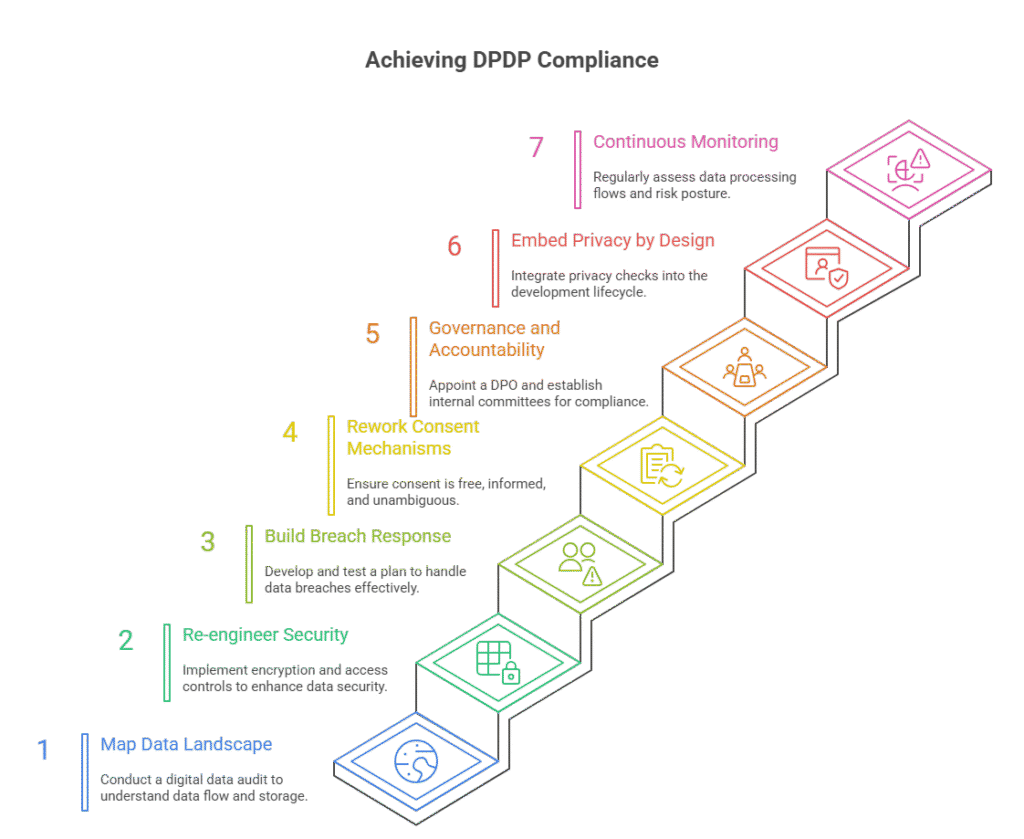
- Map Your Data Landscape
- Conduct a digital personal data audit. Identify what data you collect, how you store it, where it flows, who uses it, and how long you keep it.
- Determine whether you qualify as a Significant Data Fiduciary (SDF) — this designation carries extra obligations.
- Re-Engineer Security Architecture
- Ensure encryption, role-based access controls, and least-privilege principles are in place.
- Implement intrusion detection, anomaly monitoring, and logging tools to catch suspicious behavior early.
- Build and Test a Breach Response Plan
- Define clear notification protocols: who alerts the Data Protection Board, who communicates with affected individuals, and how quickly.
- Run tabletop exercises (simulated breach scenarios) so your teams are ready when a real incident hits.
- Rework Consent Mechanisms and Privacy Notices
- Privacy notices need to be transparent, user-friendly, and potentially multilingual (consider India’s linguistic diversity).
- Consent must be “free, informed, specific, and unambiguous” — revisit your onboarding flows, forms, and data-collection practices.
- Governance and Accountability
- Appoint a Data Protection Officer (DPO) if required; otherwise, designate a privacy lead.
- Conduct Data Protection Impact Assessments (DPIAs) for high-risk processing activities.
- Establish internal committees across legal, security, product, and operations to oversee compliance.
- Embed Privacy by Design
- Integrate privacy checks into your development lifecycle. For every new feature or product, assess data risk, consent flows, and retention.
- Train engineering, product, legal, and operations teams on DPDP-specific requirements.
- Continuous Monitoring & Audit
- Use red-teaming, penetration testing, and security audits to validate your controls.
- Reassess your data processing flows and risk posture periodically — particularly after product launches or major architectural changes.
Real-World Resonance: Lessons from Cyber Tech Journals’ Reporting
- In the Oracle data breach case at Cyber Tech Journals, legacy infrastructure vulnerabilities put millions of records at risk. The DPDP Act’s strict breach notification rules make such risk far more costly.
- The critical remote authentication bypass vulnerability in Fortinet’s products (CVE-2024-55591) underscores how even widely used network devices can pose grave threats if not patched — exactly the kind of risk that “reasonable security safeguards” must mitigate.
- Our coverage of AI threat detection tools reinforces that, under DPDP, organizations must not only secure data but proactively detect anomalous behavior.
- The rise in social engineering attacks, documented in our article on human-centric cyber threats, highlights why data protection can’t rely solely on technical controls — employee training and awareness are essential.
Broader Impacts: The New Data Protection Landscape in India
For India’s tech ecosystem, the Digital Personal Data Protection (DPDP) Act, doesn’t just introduce regulation — it signals the dawn of a more mature data protection era. Here’s how things are likely to evolve:
- Board-Level Risk Discussions Will Intensify: Companies will increasingly frame data protection as a core business risk, not just a legal checkbox.
- Privacy-First Business Models: Startups and digital-first companies may use DPDP compliance as a differentiator, building consumer trust as a competitive advantage.
- Talent Demand Shifts: Expect a surge in demand for DPOs, privacy engineers, data auditors, and DPIA specialists.
- Regulatory & Vendor Pressure: Vendors, especially cloud, AI, and analytics providers, will likely face tighter scrutiny from Indian clients, who now have legal obligations to ensure data protection.
- Global Opportunity: Indian companies that adapt effectively could become global leaders in privacy-enabling tech, especially in regions that respect strong data protection norms.
Key Challenges & Risks Ahead
Nonetheless, the road to effective DPDP implementation is not without obstacles:
- Compliance Cost: Small and medium enterprises (SMEs) may find it hard to afford the technical, legal, and human resources needed.
- Regulatory Ambiguity: Some provisions — like the precise criteria for “reasonable security safeguards” — may be open to interpretation, leading to uncertainty.
- Cross-Border Data Friction: As Indian firms operate globally, reconciling DPDP’s requirements with foreign data protection laws may be complicated.
- Execution Risk: Having policies is one thing; embedding them into engineering sprints, product roadmaps, and operations is far more difficult.
- Awareness Gap: Not all stakeholders — from board members to developers — may fully appreciate how significant the DPDP Act’s impact is, leading to underinvestment in compliance.
Conclusion: A Defining Moment for Data Protection in India
The ₹250 crore wake-up call from India’s DPDP Act 2023 is real, and its implications are profound. For tech leaders — CISOs, CTOs, product heads — the Act is not a distant regulatory threat but a present-day strategic imperative.
Bottom line: If you are a CISO, CTO, or senior executive, you need to treat the DPDP Act as a board-level risk — one that demands immediate, disciplined, and far-sighted action.
By treating data protection as a core business function, organizations can turn risk into opportunity: embedding security, earning user trust, and building resilient systems that can withstand both cyberattacks and regulatory scrutiny.
This is no longer just about compliance — it’s about shaping a safer, more responsible digital future for India.










Leave a comment