



The digital world, ever-expanding and increasingly complex, stands on the precipice of remarkable innovation. Yet, with every technological leap, new vulnerabilities emerge, making the landscape of cyber security more critical than ever. In 2025, the demand for skilled professionals across all Career Paths in Cyber Security is skyrocketing, reaching an unprecedented 4.5 million open roles worldwide, with over 500,000 jobs in the U.S. alone [1]. This isn’t just about ethical hacking anymore; the cybersecurity careers 2026 landscape is rich with diverse cyber security jobs, offering a wide array of specialized cybersecurity roles list, each playing a vital part in protecting our digital future. If you’re considering a cyber career roadmap, you’ll discover opportunities ranging from cloud security careers and SOC analyst career paths to specialized GRC cyber roles and intricate threat intelligence career positions, all requiring a robust understanding of current cybersecurity certifications 2026.
Table of Contents
Key Takeaways
- Diverse Opportunities: Cybersecurity extends far beyond traditional ethical hacking, encompassing GRC, SOC, Cloud, Threat Intelligence, and more.
- AI-Driven Transformation: AI is profoundly impacting cybersecurity, creating new roles like AI Security Engineer and AI Red Teaming Specialist, while automating many entry-level tasks.
- Skill Shift: Applied coding skills (Go, Python) are becoming more valuable, and critical thinking, problem-solving, and adaptability are paramount for strategic, AI-augmented roles.
- High Demand & Growth: The job market is experiencing massive growth, with critical shortages in specialized areas and attractive salary prospects.
- Continuous Learning: Staying updated with the latest cybersecurity certifications 2026 and technologies is crucial for career progression in this rapidly evolving field.
Introduction — Cybersecurity Roles Extend Far Beyond Hacking
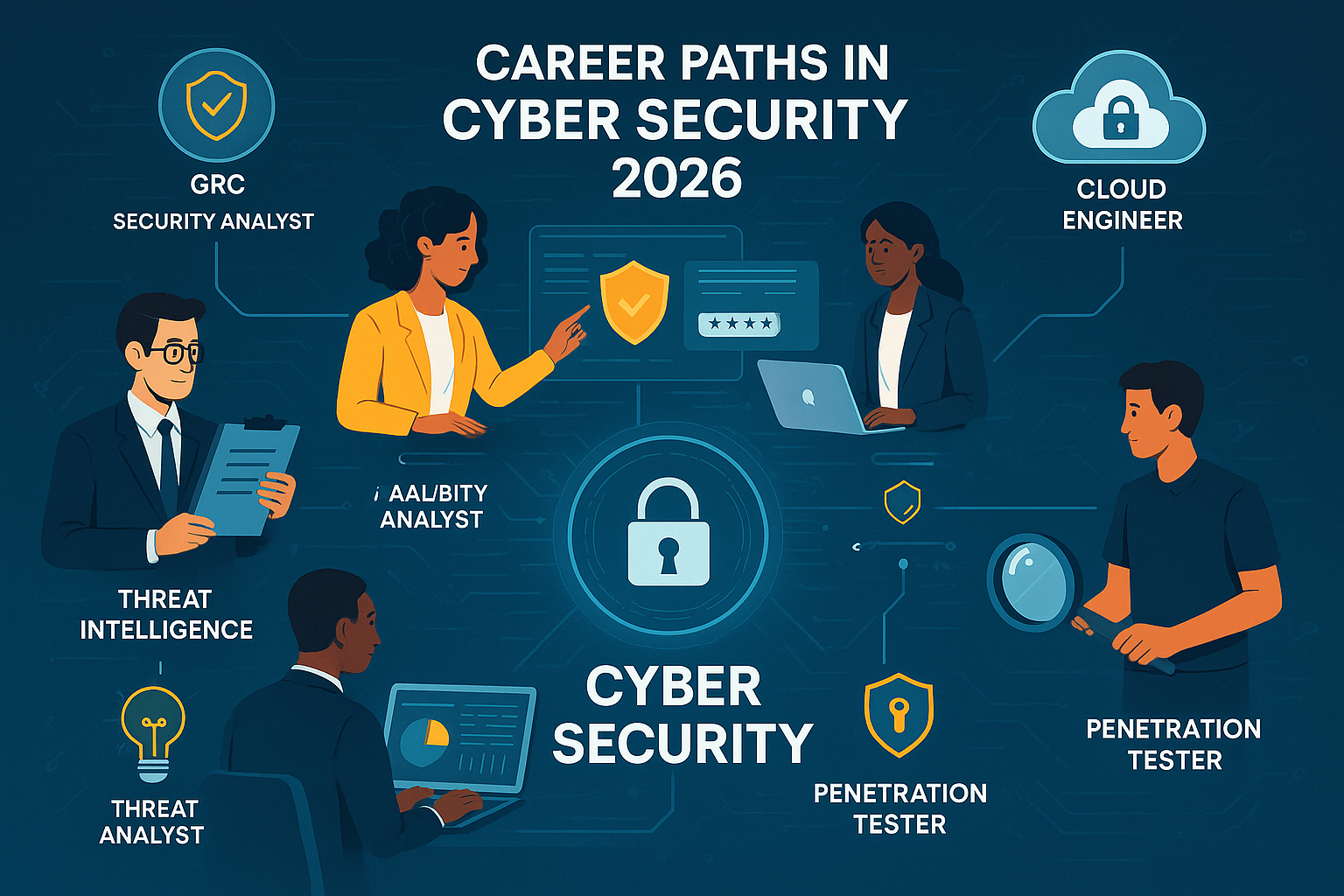
For many, the term “cybersecurity” immediately conjures images of hooded figures hunched over keyboards, breaking into systems – the classic ethical hacker. While penetration testing and vulnerability assessment remain crucial, they represent just one facet of a sprawling, intricate defense ecosystem. The reality of Career Paths in Cyber Security in 2026 is far more nuanced, encompassing a vast spectrum of specialized functions, from strategic planning and policy enforcement to forensic investigation and securing complex cloud infrastructures.
Why cybersecurity talent needs are expanding
The rapid digital transformation across all industries, coupled with an escalating volume and sophistication of cyber threats, has created a critical global talent shortage. As of October 2025, the sheer volume of open security roles underscores a pressing need for skilled professionals [1]. Seventy-eight percent of business leaders now prioritize cybersecurity as a high-priority element in their organizations, fueling this massive surge in career opportunities [2]. From nation-state attacks to ransomware gangs and insider threats, the adversaries are relentless, demanding equally robust and diverse defensive capabilities. Moreover, the integration of Artificial Intelligence (AI) into every layer of technology is not just changing how we work, but also how we secure our systems. AI-native cybersecurity teams are becoming the norm, shifting companies from mere detection to autonomous defense capabilities, creating a new wave of specialized cyber security jobs.
Misconceptions about the field
The biggest misconception is often the sole focus on “hacking.” Many believe a cybersecurity career primarily involves offensive operations. In truth, the majority of cybersecurity professionals are engaged in proactive defense, incident response, risk management, compliance, and securing complex systems. Another common misconception is that all roles are purely technical, requiring advanced coding from day one. While technical proficiency is often required, there are many critical GRC cyber roles, strategic, and even non-technical positions that contribute significantly to an organization’s security posture. The field is incredibly broad, welcoming individuals with diverse skill sets and backgrounds.
Governance, Risk & Compliance (GRC) Career Paths
GRC cyber roles are the backbone of any mature cybersecurity program. These professionals ensure that an organization adheres to legal, regulatory, and contractual obligations, manages risks effectively, and maintains a strong security posture through structured policies and controls. These are critical cybersecurity jobs for maintaining trust and avoiding costly penalties.
Security Compliance Analyst
A Security Compliance Analyst is responsible for ensuring that an organization’s information systems and data practices comply with relevant laws, regulations, and industry standards (e.g., GDPR, HIPAA, ISO 27001, PCI DSS). They perform audits, identify gaps, and recommend corrective actions.
- Key Responsibilities: Conduct compliance assessments, develop and update security policies, monitor regulatory changes, and prepare reports for internal and external stakeholders.
- Skills: Strong understanding of regulatory frameworks, attention to detail, excellent communication, and documentation skills.
Risk Manager / Risk Analyst
Risk Managers and Analysts identify, assess, and mitigate potential cybersecurity risks to an organization’s assets. They quantify the impact of potential threats and vulnerabilities, helping leadership make informed decisions about where to invest security resources.
- Key Responsibilities: Perform risk assessments, develop risk treatment plans, track risk metrics, and advise on risk tolerance levels.
- Skills: Analytical thinking, knowledge of risk management frameworks (e.g., NIST RMF), business acumen, and strong communication.
Data Privacy & DPDP/GDPR Specialist
With increasing global emphasis on data protection, these specialists are in high demand. They focus on ensuring compliance with privacy regulations like Europe’s GDPR (General Data Protection Regulation) and India’s DPDP (Digital Personal Data Protection) Act 2023. Understanding the nuances of DPDP Act 2023: 250 Crore Wake-Up Call is crucial for professionals in this domain.
- Key Responsibilities: Develop privacy policies, conduct privacy impact assessments, manage data subject requests, and advise on data handling practices.
- Skills: Deep knowledge of data privacy laws, legal interpretation, communication, and project management.
ISO 27001 / SOC 2 Auditor
These auditors assess an organization’s Information Security Management System (ISMS) against the ISO 27001 standard or evaluate its controls relevant to security, availability, processing integrity, confidentiality, and privacy for a SOC 2 report.
- Key Responsibilities: Plan and conduct audits, identify non-conformities, evaluate control effectiveness, and provide recommendations for improvement.
- Skills: Auditing principles, understanding of ISO 27001 and SOC 2 frameworks, attention to detail, and impartiality. For a comprehensive guide, explore ISO 27001 certification.
Security Operations & Defense Roles
The Security Operations Center (SOC) is the nerve center of an organization’s defense, continuously monitoring, detecting, analyzing, and responding to cyber threats. These cybersecurity roles are on the front lines, actively safeguarding digital assets.
SOC Analyst (L1/L2/L3)
SOC Analysts are the first responders to security incidents. The role typically progresses through levels (L1, L2, L3) with increasing responsibility and expertise.
- L1 (Tier 1): Monitors security alerts, performs initial triage, and escalates incidents.
- L2 (Tier 2): Investigates escalated incidents, performs deeper analysis, and coordinates response efforts.
- L3 (Tier 3) / Senior: Hunts for threats proactively, develops detection rules, mentors junior analysts, and contributes to security architecture.
- Skills: SIEM tools, network protocols, incident response procedures, analytical thinking, and attention to detail.
Incident Response Specialist
When a cyberattack occurs, Incident Response Specialists spring into action. Their primary goal is to contain, eradicate, and recover from security incidents as quickly and effectively as possible, minimizing damage and downtime. For those looking to prepare, knowing how to prepare for a cyber attack is essential.
- Key Responsibilities: Execute incident response plans, perform forensic analysis, coordinate with internal teams and external agencies, and develop post-incident reports.
- Skills: Deep understanding of attack methodologies, forensic tools, communication under pressure, and problem-solving. The ability to manage automated cybersecurity incident response systems is also increasingly vital.
Digital Forensics Expert
These experts specialize in collecting, preserving, and analyzing digital evidence in a legally sound manner. They are crucial for understanding the scope of a breach, identifying attackers, and supporting legal proceedings.
- Key Responsibilities: Recover deleted files, analyze system logs, investigate network traffic, and provide expert testimony.
- Skills: Forensic tools (e.g., EnCase, FTK), operating system internals, scripting (Python), and legal understanding.
Malware Reverse Engineer
Malware Reverse Engineers dismantle malicious software to understand its functionality, origin, and impact. This intelligence is vital for developing effective detection and prevention strategies.
- Key Responsibilities: Disassemble and decompile malware, analyze its behavior, extract indicators of compromise (IOCs), and write detailed reports.
- Skills: Assembly language, debuggers, disassemblers (e.g., Ghidra, IDA Pro), knowledge of operating systems, and scripting. For more on how to counter such threats, consider exploring 7 malware removal steps to take immediately.
Threat Intelligence & Research Careers
Threat Intelligence professionals are the eyes and ears of the cybersecurity world, gathering, analyzing, and disseminating information about current and emerging threats to help organizations anticipate and defend against attacks. These are predictive and analytical cybersecurity jobs.
Threat Intelligence Analyst
Threat Intelligence Analysts collect and analyze data from various sources (open source, dark web, proprietary feeds) to understand threat actors, their tactics, techniques, and procedures (TTPs), and potential vulnerabilities.
- Key Responsibilities: Monitor threat feeds, produce intelligence reports, identify relevant threats to the organization, and integrate intelligence into defensive measures.
- Skills: OSINT (Open Source Intelligence), analytical skills, report writing, knowledge of threat landscapes, and data analysis. The rise of [Law Enforcement-Centric Threat Intelligence Platforms] in 2026 highlights the growing collaboration and demand for shared intelligence.
Vulnerability Researcher
These researchers actively seek out and identify weaknesses (vulnerabilities) in software, hardware, and networks. They often participate in bug bounty programs or work for security vendors.
- Key Responsibilities: Conduct penetration tests, analyze code for flaws, develop proof-of-concept exploits, and report vulnerabilities responsibly.
- Skills: Programming (Go, Python), reverse engineering, exploit development, and deep understanding of system architecture.
Cybercrime Investigator
Working closely with law enforcement or within large organizations, Cybercrime Investigators pursue perpetrators of cyber fraud, theft, and other digital crimes.
- Key Responsibilities: Trace digital footprints, interview witnesses, liaise with law enforcement, and prepare evidence for prosecution.
- Skills: Digital forensics, legal understanding, investigative techniques, and strong communication.
Cloud Security & DevSecOps Roles
As organizations increasingly migrate to cloud platforms and adopt agile development methodologies, the demand for professionals specializing in cloud security careers and DevSecOps is soaring. These roles are pivotal in securing modern, dynamic IT environments.
Cloud Security Engineer (AWS/Azure/GCP)
Cloud Security Engineers design, implement, and manage security controls within cloud environments (Amazon Web Services, Microsoft Azure, Google Cloud Platform). They are critical for ensuring data privacy, compliance, and resilience in the cloud. They are emerging as critical roles requiring expertise in Infrastructure as Code (IaC) security, zero-trust architecture, and AI-orchestrated infrastructure design [3].
- Key Responsibilities: Configure cloud security groups, implement identity and access management (IAM) policies, secure containerized workloads, and monitor cloud security posture.
- Skills: Expertise in specific cloud platforms, IaC tools (Terraform, CloudFormation), network security, and scripting. Understanding cloud security best practices is paramount.
DevSecOps Engineer
DevSecOps integrates security practices into every stage of the software development lifecycle (SDLC). A DevSecOps Engineer automates security checks and processes, ensuring that security is “baked in,” not bolted on.
- Key Responsibilities: Implement security tools in CI/CD pipelines, conduct static and dynamic application security testing (SAST/DAST), manage secrets, and ensure compliance in development.
- Skills: Programming (Go, Python), CI/CD tools, containerization (Docker, Kubernetes), security testing tools, and automation.
Container & Kubernetes Security Specialist
With the widespread adoption of containerization, securing these environments is a specialized and high-demand skill. These specialists focus on the unique security challenges presented by Docker, Kubernetes, and other container orchestration platforms.
- Key Responsibilities: Secure container images, manage Kubernetes network policies, implement runtime security, and monitor containerized applications for vulnerabilities.
- Skills: Docker, Kubernetes, container security tools, Linux internals, and network segmentation.
Architecture & Engineering Career Tracks
Security Architects and Engineers are responsible for designing, building, and maintaining robust security systems and infrastructure. These roles require a deep understanding of technology and strategic thinking to create resilient defenses.
Security Architect
A Security Architect designs and plans an organization’s overall security infrastructure and strategy. They ensure that security is integrated into every aspect of IT systems and business processes.
- Key Responsibilities: Develop security roadmaps, select security technologies, design secure network architectures, and ensure compliance with security standards.
- Skills: Enterprise architecture, knowledge of various security domains, strategic thinking, and strong communication.
Network Security Engineer
Network Security Engineers focus on securing an organization’s network infrastructure, including firewalls, intrusion detection/prevention systems (IDS/IPS), VPNs, and other network devices. Knowing the best business firewalls in 2025 is key.
- Key Responsibilities: Configure and manage network security devices, implement network segmentation, monitor network traffic for anomalies, and respond to network-based attacks.
- Skills: Networking protocols (TCP/IP), firewall management, IDS/IPS, VPNs, and network forensics.
Identity & Access Management (IAM) Architect
IAM Architects design and implement systems that manage user identities and control their access to resources. This is a crucial area for preventing unauthorized access and maintaining compliance.
- Key Responsibilities: Design identity governance frameworks, implement single sign-on (SSO) and multi-factor authentication (MFA) solutions, manage privilege access, and integrate IAM with cloud services.
- Skills: IAM platforms (Okta, Azure AD), directory services (LDAP), authentication protocols (OAuth, SAML), and scripting.
Consulting, Product & Leadership Paths
For those with a broader vision and a knack for strategy, these Career Paths in Cyber Security offer significant influence and impact.
Cybersecurity Consultant
Consultants provide expert advice to organizations on various security matters, from strategy development and risk assessments to incident response and compliance.
- Key Responsibilities: Assess client security posture, develop tailored security solutions, provide training, and assist with implementing security controls.
- Skills: Broad cybersecurity knowledge, excellent communication, problem-solving, and client management.
Cybersecurity Product Manager
Product Managers in cybersecurity define the vision, strategy, and roadmap for security products or features. They bridge the gap between technical teams and business needs.
- Key Responsibilities: Conduct market research, gather customer requirements, define product features, and oversee the product lifecycle.
- Skills: Product management methodologies, understanding of cybersecurity technologies, business acumen, and communication.
CISO / Security Leadership Roles
The Chief Information Security Officer (CISO) is a senior executive responsible for an organization’s entire information security program. This is the pinnacle of many cybersecurity careers 2026. For those aspiring to this, learning how to become a CISO is a valuable step.
- Key Responsibilities: Develop and implement security strategy, manage security budgets, lead security teams, communicate risks to the board, and ensure regulatory compliance.
- Skills: Leadership, strategic planning, risk management, business leadership, and deep technical and governance knowledge. The AI impact on the CISO role in 2025 is also a significant consideration for aspiring leaders.
Non-Technical Cybersecurity Careers
Not all essential cybersecurity jobs require deep technical coding skills. Many crucial roles leverage different strengths to strengthen an organization’s overall security posture.
Policy Analyst
Policy Analysts develop, review, and update cybersecurity policies and procedures to align with organizational goals, legal requirements, and industry best practices.
- Key Responsibilities: Research regulations, draft security policies, ensure policies are communicated and enforced, and conduct policy compliance audits.
- Skills: Strong writing, analytical thinking, understanding of legal frameworks, and attention to detail.
Cybersecurity Trainer / Educator
These professionals are vital for raising security awareness among employees and for developing the next generation of cybersecurity talent. They deliver training, create educational materials, and mentor others.
- Key Responsibilities: Develop cybersecurity awareness programs, conduct workshops, create course content, and stay updated on latest threats.
- Skills: Public speaking, instructional design, communication, and strong grasp of cybersecurity fundamentals. Teaching employees how to train employees on cybersecurity awareness is a key aspect.
Cybersecurity Writer / Documentation Specialist
Clear, concise documentation is essential in cybersecurity. Writers create policies, procedures, incident reports, user guides, and training materials, making complex technical information accessible.
- Key Responsibilities: Write and edit security documentation, collaborate with technical teams, ensure accuracy and consistency, and maintain documentation repositories.
- Skills: Excellent writing and editing, technical understanding, attention to detail, and communication.
Essential Skills & Certifications for 2026
To thrive in the diverse cybersecurity roles list for 2026, a blend of technical prowess and critical soft skills is indispensable.
Technical skills
- Programming/Scripting: Applied coding skills in Go and Python are increasingly valued over theoretical knowledge, marking a significant shift in required competencies [4]. PowerShell, Bash, and JavaScript are also highly relevant.
- Network and Cloud Security: Deep understanding of network protocols, firewalls, cloud platforms (AWS, Azure, GCP), and secure cloud configurations.
- Operating Systems: Proficiency in Linux, Windows, and macOS security.
- Security Tools: SIEM, EDR, vulnerability scanners, penetration testing tools, forensic tools.
- Automation: Experience with automation frameworks and tools is becoming crucial, especially with the rise of AI in cybersecurity.
Soft skills
- Problem-Solving: The ability to analyze complex issues and devise effective solutions.
- Critical Thinking: Evaluating information objectively to make sound judgments.
- Communication: Clearly articulating technical concepts to non-technical audiences, writing comprehensive reports, and collaborating effectively.
- Adaptability: The cybersecurity landscape is constantly changing, requiring professionals to continuously learn and adapt.
- Teamwork: Most cybersecurity operations are collaborative efforts.
Certification mapping by role
Pursuing relevant cybersecurity certifications 2026 is a strategic move to validate skills and enhance career prospects.
- Entry-Level (Cyber Career Roadmap): CompTIA Security+, CySA+, CCNA Cyber Ops.
- GRC Cyber Roles: CISA (Certified Information Systems Auditor), CISM (Certified Information Security Manager), CRISC (Certified in Risk and Information Systems Control).
- SOC Analyst Career / Incident Response: GCIH (GIAC Certified Incident Handler), GCFA (GIAC Certified Forensic Analyst).
- Cloud Security Careers: AWS Certified Security – Specialty, Azure Security Engineer Associate, Google Cloud Professional Security Engineer.
- Security Architecture/Engineering: CISSP (Certified Information Systems Security Professional), CCSP (Certified Cloud Security Professional), OSCP (Offensive Security Certified Professional) for penetration testing roles.
- AI Security Roles: Emerging certifications focused on AI security, model governance, and securing AI/ML pipelines will be critical.
Salary Trends & Job Market Outlook for 2026
The cybersecurity job market in 2026 continues its explosive growth, driven by escalating threats and technological advancements, particularly AI.
Entry-level to expert salary ranges
Salaries in cybersecurity are highly competitive, reflecting the critical demand. While entry-level salaries can vary, experienced professionals, especially in specialized domains, command significant compensation.
- Entry-Level (0-2 years): Typically ranges from $60,000 – $90,000+.
- Mid-Level (3-7 years): Can range from $90,000 – $140,000+.
- Senior/Expert (8+ years): Often exceeds $150,000+, with CISO and highly specialized roles reaching $200,000 – $400,000+.
- High-Demand Roles: Roles like AI Security Engineers focusing on securing AI pipelines, memory systems, agents, and model governance are among the highest-demand and highest-paying in 2026 [5]. Cloud Security Architects/Engineers are also seeing significant salary growth.
Skills in highest demand
Beyond general cybersecurity knowledge, specific skills are creating critical shortages:
- AI Security: Securing AI systems, AI red teaming, and AI model governance. AI red teaming specialists represent a massive growth area as AI failures become new vectors for breaches and cyberattacks [6].
- Cloud Security: Expertise in multi-cloud environments, IaC security, and zero-trust architecture.
- Identity Security Posture Management: Ensuring robust identity and access controls.
- Red Team Specialists: Advanced offensive security skills for realistic threat simulation.
- Mobile Threat Analysts: Securing mobile applications and devices.
- Applied Coding: Proficiency in Go and Python for automation and security tool development.
How to Choose the Right Cybersecurity Path
Navigating the multitude of Career Paths in Cyber Security can seem daunting, but a structured approach can help you find your niche.
Personality match
Consider your interests and working style:
- Analytical/Investigative: Threat Intelligence, Digital Forensics, Malware Reverse Engineering.
- Structured/Detail-Oriented: GRC cyber roles, Compliance Analyst, Auditor.
- Problem-Solver/Hands-On: SOC Analyst, Incident Response, Network Security Engineer.
- Creative/Strategic: Security Architect, Cybersecurity Consultant, CISO.
- Educator/Communicator: Trainer, Policy Analyst, Writer.
Career roadmaps
Develop a personalized cyber career roadmap. Start with foundational knowledge, gain experience, then specialize. Many resources offer guidance, such as this general cybersecurity roadmap 2025.
- Foundational Knowledge: Learn networking, operating systems, and basic security concepts.
- Entry-Level Roles: Consider SOC Analyst (L1), Help Desk with a security focus, or Security Internships.
- Specialization: Identify areas that align with your interests and the market demand (e.g., cloud security, GRC, threat intelligence).
- Continuous Learning: The field evolves rapidly, so continuous learning through certifications, courses, and industry engagement is non-negotiable.
Recommended learning path
- Start with Basics: CompTIA A+, Network+, Security+ are excellent starting points.
- Hands-On Practice: Build a home lab, participate in CTFs (Capture The Flag) challenges, and practice scripting.
- Specialize: Once you have a foundation, dive deep into your chosen area. For instance, if cloud security calls to you, pursue AWS/Azure/GCP certifications.
- Internships: Gain practical experience through internships.
Final Thoughts — The Future of Cyber Careers in 2026
The cybersecurity landscape in 2026 is one of immense opportunity and constant evolution. The notion that cybersecurity is solely for “hackers” is a relic of the past; the industry now demands a diverse skill set to combat increasingly sophisticated threats. AI will reshape many aspects of cybersecurity, automating routine tasks and simultaneously elevating the importance of human strategic thinking and specialized expertise. While the barrier to entry for automated cybersecurity tasks is collapsing, the barrier to strategic, AI-augmented roles is rising dramatically [7]. Gartner predicts that by 2028, generative AI adoption will collapse the skills gap, removing the need for specialized education from 50% of entry-level cybersecurity positions through job restructuring [8]. This means a focus on critical thinking, problem-solving, and continuous learning will be more important than ever for a thriving career.
Whether you’re drawn to the meticulous world of GRC, the fast-paced environment of a SOC analyst career, the strategic depth of threat intelligence, or the cutting-edge innovation of cloud security careers, there’s a vital role for you. The future of cyber security jobs is secure, challenging, and profoundly impactful. Embrace lifelong learning, cultivate both technical and soft skills, and you will find a rewarding journey ahead in the dynamic world of Career Paths in Cyber Security.













Leave a comment