



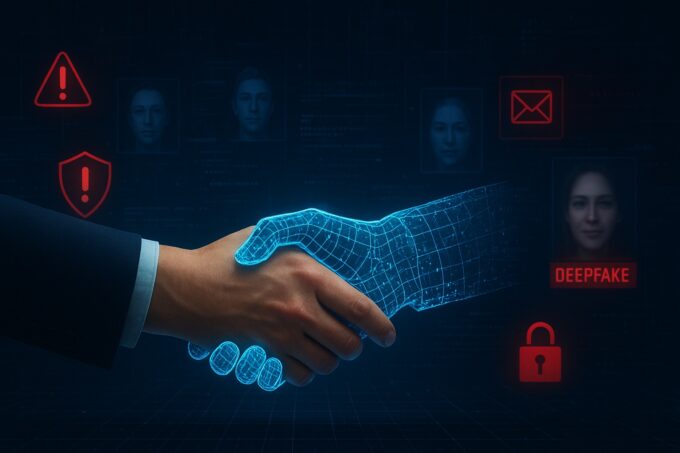
Picture this: Your CEO joins a video call with the finance team. The face is familiar. The voice is perfect. Every mannerism matches. She authorizes a $25 million wire transfer to a new vendor account. The transaction clears within hours.
There’s just one problem: It wasn’t actually her.
This isn’t a hypothetical scenario. In early 2024, a multinational corporation lost exactly this amount when finance staff participated in a video conference with what appeared to be their CEO and other senior executives. Every person on that call was an AI-generated deepfake avatar. The technology was so convincing that multiple employees, trained in cybersecurity awareness, never suspected a thing.
Welcome to 2026, where your biggest security threat isn’t a faceless hacker halfway across the world. It’s the erosion of trust itself.
Machine identities now outnumber human employees by 82 to 1. Deepfake technology can clone a voice from just 15 seconds of audio. And the old cybersecurity playbook—the one that starts with “prevent, detect, respond”—is officially obsolete.
What’s replacing it? A fundamental shift from prevention to resilience, from protecting perimeters to verifying identities, and from reactive defense to continuous adaptation. This is the identity crisis, and it’s reshaping everything we thought we knew about cybersecurity.
Table of Contents
The Perfect Storm: When AI Makes Everyone Unverifiable
The Deepfake CEO You Can’t Spot
The technology behind deepfakes has evolved from a novelty to an existential threat in less than three years. Today’s AI-powered social engineering attacks don’t just mimic voices—they replicate facial expressions, body language, and speech patterns with frightening accuracy.
Consider what security researchers discovered in late 2025: Using publicly available AI tools and just $50, attackers created a convincing video deepfake of a Fortune 500 CEO that fooled professional fraud analysts 73% of the time. The technology required no specialized skills, no expensive equipment, and minimal training.
The implications are staggering. According to Forrester’s 2026 Cybersecurity Predictions, an agentic AI deployment will cause a major public breach this year, leading to employee dismissals and potential regulatory consequences. These autonomous AI systems can now conduct sophisticated attacks independently, learning from failed attempts and adapting their tactics in real-time.
The Machine Identity Explosion
While everyone focuses on deepfakes targeting humans, a quieter crisis is unfolding in the background: the explosion of machine identities. Every API, service account, bot, and automated workflow represents a digital identity that needs authentication and authorization. And unlike human employees who go home at night, these machine identities operate 24/7, making them attractive targets for persistent attackers.
The math is sobering: The average enterprise now manages over 100,000 machine identities, compared to just 1,200 human users. That’s an 82:1 ratio, and it’s growing. Each of these machine identities represents a potential attack vector. Compromising a single service account can give attackers the keys to entire systems, with none of the behavioral red flags that might alert security teams when a human account is compromised.
Traditional identity and access management (IAM) systems weren’t designed for this scale. They assumed identity meant a person logging in from a known location. In 2026, that assumption is dangerously outdated.
Real-Time Identity Verification Challenges
The challenge isn’t just detecting fake identities—it’s doing so in real time, at scale, without disrupting legitimate business operations. Every second of delay in a modern transaction costs money. Yet every shortcut in identity verification creates vulnerability.
Multi-factor authentication (MFA), once considered the gold standard, is now regularly bypassed through sophisticated phishing attacks that capture authentication codes or use compromised sessions. Biometric authentication, touted as the solution to password problems, faces challenges from both deepfakes and the growing privacy concerns around storing sensitive biometric data.
Research from NIST emphasizes that effective identity verification in a zero trust environment requires continuous authentication throughout a session, not just at login. This means constantly monitoring behavior, device posture, location, and access patterns—a computational and operational challenge that many organizations are still struggling to meet.
Why Prevention Is Dead (And What Killed It)
From Perimeter Defense to Assume Breach
For decades, cybersecurity operated on a simple premise: Build strong walls, and everything inside is safe. Organizations invested billions in perimeter defenses—firewalls, intrusion detection systems, virtual private networks (VPNs)—all designed to keep the bad guys out.
That model is dead. Not dying. Dead.
The shift to cloud computing, remote work, and distributed applications has eliminated the traditional network perimeter. Your employees access corporate resources from coffee shops, home offices, and airport lounges. Your applications run in multiple cloud environments. Your partners and contractors need access to specific systems. There is no “inside” anymore.
More critically, the assumption that threats come from outside has been thoroughly disproven. According to the 2025 Verizon Data Breach Investigations Report, 25% of breaches involved internal actors, and 74% included the human element—whether through social engineering, misuse of privileges, or simple errors.
The new model, embraced by organizations following NIST’s Zero Trust Architecture framework, assumes that breaches will occur. The question isn’t if your defenses will be penetrated, but when—and whether you can detect, contain, and recover before significant damage occurs.
The Velocity Gap: AI Speed vs. Human Response
Perhaps the most compelling reason prevention has failed is the sheer speed of modern attacks. AI-powered malware can scan an entire network, identify vulnerabilities, move laterally through systems, and exfiltrate data in minutes. Human security analysts, no matter how skilled, operate at human speed.
This velocity gap is widening. Gartner’s 2026 Strategic Technology Trends highlight “preemptive cybersecurity” as essential, noting that by 2030, preemptive solutions will account for half of all security spending. But even preemptive measures require response times measured in milliseconds, not minutes.
Consider a typical ransomware attack in 2026: Attackers gain initial access through a compromised credential. Within 90 seconds, automated reconnaissance tools map the network. Within five minutes, lateral movement begins. Within 15 minutes, data exfiltration starts. By the time most security operations centers (SOCs) detect anomalous behavior and begin investigation—typically 4-6 hours later—the damage is done.
Prevention → Detection → Response is Too Slow
The traditional cybersecurity model follows a linear path: Prevent attacks from entering, detect those that get through, respond to confirmed threats. This model assumes you have time—time to investigate, time to analyze, time to coordinate a response.
You don’t.
Modern attackers, particularly those using agentic AI and autonomous malware, operate at machine speed and at scale. They’re testing thousands of potential attack vectors simultaneously. They’re using AI to craft perfectly personalized phishing emails for every employee in your organization. They’re exploiting zero-day vulnerabilities before security vendors even know they exist.
The new model must be: Resilience → Recovery → Continuous Adaptation. It assumes compromise and focuses on limiting damage, recovering quickly, and learning from each incident to strengthen future defenses. This isn’t pessimism—it’s realism informed by the actual threat landscape of 2026.
As detailed in our guide to Enterprise Cybersecurity Policy, modern security frameworks must build resilience into every layer, not just at the perimeter.
The AI Arms Race: When Attackers and Defenders Both Use AI
Agentic AI: Attackers Using Autonomous Agents
The most significant evolution in cyber threats for 2026 is the rise of agentic AI—autonomous artificial intelligence agents that can conduct complex, multi-step attacks with minimal human intervention. Unlike traditional malware that follows pre-programmed instructions, agentic AI makes decisions, adapts to defenses, and learns from failures in real time.
These AI agents can:
- Conduct autonomous reconnaissance, mapping networks and identifying vulnerabilities faster than any human analyst
- Craft personalized attacks for every target, using publicly available information to create convincing social engineering scenarios
- Adapt tactics mid-attack when defenses are encountered, trying alternative approaches without needing to phone home for instructions
- Coordinate with other compromised systems to orchestrate distributed attacks that appear as normal traffic patterns
The implications for organizations are profound. Traditional signature-based detection, which relies on recognizing known attack patterns, fails completely against adaptive AI. Even behavioral analytics struggle when attackers use AI to mimic legitimate user behavior with sufficient accuracy to avoid triggering alerts.
Defenders Deploying AI for Real-Time Threat Detection
The good news—if there is any—is that defenders are also leveraging AI. The latest generation of security tools uses machine learning for real-time threat detection, behavioral analysis, and automated response.
According to industry data, 67% of organizations now use AI as part of their cybersecurity strategy, with 31% relying on it extensively. The global AI in cybersecurity market is projected to grow from $35.22 billion in 2025 to $79.09 billion in 2029, reflecting the critical importance of these technologies.
Modern AI-powered security platforms can:
- Establish behavioral baselines for every user and system, detecting anomalies that would be invisible to human analysts
- Correlate data across multiple sources in real time, identifying attack patterns that span network segments, endpoints, and cloud services
- Automate initial response actions, containing threats in seconds rather than hours
- Predict likely attack vectors based on vulnerability intelligence and threat actor behavior
Platforms like CrowdStrike’s Charlotte AI, Darktrace’s Cyber AI Analyst, and Hunters’ AI-driven SIEM demonstrate the potential of defensive AI to level the playing field against sophisticated attackers.
The Automation Advantage: Who Wins the Speed War?
The ultimate question in the AI arms race isn’t about sophistication—it’s about speed and scale. Whoever can operate faster, at greater scale, with more consistent execution wins.
Currently, attackers have an advantage. They can launch thousands of simultaneous attacks, testing defenses across entire industries. They can iterate on failures without consequences. They face no regulatory constraints, no budget committees, no procurement processes.
Defenders face all these challenges. But defenders have one critical advantage: They know their own environment. They have context about normal operations, legitimate users, and expected behaviors. The key is using AI to leverage this contextual knowledge faster than attackers can adapt.
Organizations implementing zero trust architectures with AI-powered continuous verification are seeing significant improvements. They’re detecting compromises in minutes instead of months, containing breaches before data exfiltration occurs, and recovering operations in hours instead of weeks.
Shadow AI and Unauthorized AI Tools
While security teams deploy official AI tools, a parallel problem emerges: Shadow AI. Employees, frustrated with slow corporate IT processes or enticed by the productivity promises of new AI tools, are bringing unauthorized AI into the enterprise.
Every ChatGPT query from a corporate laptop, every AI-powered coding assistant, every AI meeting transcription service represents potential data leakage. These tools typically upload data to external servers for processing, creating copies of sensitive information outside organizational control.
The risk compounds when these unofficial AI tools become compromised. Attackers are already creating malicious AI services specifically designed to capture enterprise data from unwitting users. The pitch is compelling: “Get better AI capabilities than your company provides, for free!” The reality is a data exfiltration tool masquerading as a productivity enhancer.
Addressing shadow AI requires both technical controls—data loss prevention (DLP) systems that detect and block unauthorized data transfers—and cultural changes that provide employees with approved AI tools powerful enough to meet their needs.
The Identity-First Security Framework
Zero Trust 2.0: Context-Aware, Continuous Verification
Zero Trust architecture has evolved from a buzzword to a fundamental requirement for modern cybersecurity. However, the zero-trust security of 2026 appears quite different from the implementations of 2023.
Zero Trust 2.0 goes beyond “never trust, always verify” to embrace “verify continuously, with full context.” Every access request is evaluated not just on who is asking, but:
- What device they’re using and its security posture
- Where they’re connecting from and whether that location makes sense
- When they’re making the request relative to normal patterns
- What data they’re trying to access and their actual need-to-know
- How they’re authenticated and the strength of that authentication
- Why this access request differs from their typical behavior
This comprehensive approach requires integration across identity management, endpoint security, network monitoring, and application controls. It’s not a single product but an architectural approach that permeates every security decision.
The NIST Zero Trust Architecture framework provides comprehensive guidance on implementing these principles, emphasizing that zero trust is a journey, not a destination. Organizations should expect a multi-year transition with measurable improvements at each stage.
Behavioral Biometrics Beyond Passwords
Passwords are dead. MFA is necessary but insufficient. The future of authentication lies in behavioral biometrics—continuously monitoring how users interact with systems to verify their identity.
Behavioral biometric systems analyze:
- Typing patterns: The unique rhythm and speed at which individuals type
- Mouse movements: How users navigate interfaces and select options
- Mobile gestures: Swipe patterns, pressure sensitivity, and device orientation
- Application usage: Which apps are accessed, in what order, and for how long
- Network behavior: Connection patterns, data access rhythms, and communication flows
The power of behavioral biometrics is that they’re nearly impossible to fake. An attacker might steal credentials, but they can’t replicate the thousands of micro-behaviors that characterize how a specific person interacts with systems. These patterns are so distinctive that they’re sometimes called “digital fingerprints.”
Modern implementations use machine learning to build sophisticated behavioral profiles that adapt as user behavior evolves naturally while flagging anomalies that suggest account compromise. When behavioral analysis detects something suspicious, systems can require step-up authentication or limit access until identity is confirmed.
Identity Threat Detection and Response (ITDR)
As identity becomes the primary attack vector, a new category of security tools has emerged: Identity Threat Detection and Response (ITDR). These platforms specifically focus on detecting and responding to identity-based attacks that traditional security tools miss.
ITDR platforms monitor:
- Unusual privilege escalation attempts or successful elevation without proper justification
- Anomalous access patterns to sensitive resources from otherwise legitimate accounts
- Credential sharing or reuse across multiple systems or locations
- Dormant account activation when long-unused accounts suddenly become active
- Machine identity anomalies like API keys used from unexpected locations or at unusual times
The value of ITDR becomes clear when you consider that most major breaches involve compromised credentials rather than technical exploits. Organizations with ITDR capabilities detect account compromise in days instead of months, dramatically reducing the window of opportunity for attackers to conduct reconnaissance, move laterally, and exfiltrate data.
Leading ITDR solutions integrate with existing IAM infrastructure, SIEM platforms, and endpoint protection to provide a comprehensive view of identity-related threats across the entire attack surface.
Machine Identity Governance
With machine identities outnumbering humans 82:1, effective machine identity governance has become critical. Yet most organizations have no comprehensive inventory of their machine identities, let alone policies for managing their lifecycle.
Machine identity governance requires:
- Complete inventory: Knowing every API key, service account, bot, and automated process
- Lifecycle management: Provisioning, rotating, and deprovisioning machine credentials
- Usage monitoring: Tracking when and how machine identities access resources
- Risk assessment: Identifying high-privilege machine accounts that could cause catastrophic damage if compromised
- Automated response: Revoking or restricting machine identities that exhibit suspicious behavior
Organizations implementing comprehensive machine identity management report significant improvements in their security posture. They discover “shadow” service accounts that no one knew existed. They identify API keys that haven’t been rotated in years. They find machine identities with excessive privileges that can be restricted to reduce blast radius.
The challenge is scale. Manual management of 100,000+ machine identities is impossible. Successful implementations rely heavily on automation, using tools that can discover, inventory, monitor, and manage machine identities programmatically.
Deepfake Detection Protocols
As deepfake technology becomes more sophisticated, organizations must implement specific protocols for detecting and responding to synthetic media attacks. This is particularly critical for high-risk scenarios like:
- Executive authorization of financial transactions or policy changes
- Customer service interactions where identity verification is required
- Internal communications about sensitive topics or decisions
- Board meetings and other high-level governance activities
Effective deepfake detection combines multiple approaches:
Technical detection: AI-powered tools that analyze video and audio for subtle artifacts that indicate synthetic generation. These tools look for inconsistencies in facial movements, lighting, audio synchronization, and pixel-level patterns that humans can’t perceive but algorithms can detect.
Process controls: Multi-channel verification for high-risk requests. If the CEO sends an urgent email requesting a wire transfer, require voice confirmation on a known phone number. If that voice authorizes the transfer, require video confirmation with real-time questions only the CEO could answer.
Human training: Educating employees on deepfake capabilities and red flags. While technical detection is essential, human vigilance remains a critical defense layer. The finance employee who thinks “this doesn’t feel right” and initiates additional verification could prevent a multi-million dollar loss.
Incident response planning: Pre-defined procedures for responding when a deepfake attack is detected or suspected. Who needs to be notified? What accounts should be immediately locked? How do you verify the identity of the person you’re calling to report the incident?
For more information on protecting against sophisticated fraud, see our guide on ransomware attacks and recovery.
The Recovery Playbook: When (Not If) You’re Breached
Building Resilience, Not Just Defenses
The fundamental mindset shift in modern cybersecurity is from “preventing breaches” to “building resilience.” This doesn’t mean abandoning preventive measures—those remain important—but rather acknowledging that determined attackers with sufficient resources will eventually find a way in.
Resilience means:
- Assuming compromise: Designing systems and processes that limit damage even when defenses fail
- Layered controls: Implementing defense in depth so that breaching one layer doesn’t compromise everything
- Rapid detection: Minimizing the time attackers spend in your environment undetected
- Containment capabilities: Being able to isolate compromised systems quickly to prevent lateral movement
- Recovery readiness: Maintaining the ability to restore operations even if primary systems are compromised
Organizations with mature resilience programs conduct regular tabletop exercises that simulate various breach scenarios, including some of the most concerning threats like ICS cybersecurity breaches in critical infrastructure.
Automated Incident Response Workflows
Speed is everything in incident response. The difference between detecting a breach in five minutes versus five hours could mean the difference between a minor incident and a catastrophic data loss.
Automated incident response workflows use orchestration platforms to execute pre-defined playbooks when specific threats are detected:
- Malware detection: Automatically isolate the infected endpoint, kill malicious processes, collect forensic data, and alert analysts
- Unusual data access: Immediately restrict account privileges, require re-authentication, and flag for investigation
- Suspicious lateral movement: Isolate network segments, terminate suspicious connections, and escalate to senior security staff
- Ransomware indicators: Trigger immediate backup verification, network isolation, and activation of recovery procedures
The key is that these responses happen in seconds, not hours. By the time a human analyst even sees the alert, initial containment actions have already been taken. This speed dramatically reduces the window of opportunity for attackers.
Platform Consolidation: EDR, XDR, SOAR
One of the major trends in cybersecurity for 2026 is platform consolidation. Organizations are moving away from managing dozens of point security solutions toward integrated platforms that provide broader visibility and more coordinated response.
Endpoint Detection and Response (EDR) monitors individual devices for threats, providing detailed visibility into what’s happening on laptops, servers, and mobile devices. Modern EDR solutions use AI to detect even novel attack techniques that don’t match known signatures.
Extended Detection and Response (XDR) takes EDR’s approach and applies it across the entire attack surface—endpoints, networks, cloud workloads, and applications. By correlating data from multiple sources, XDR provides a holistic view of attacks that might appear benign when looking at any single data source.
Security Orchestration, Automation, and Response (SOAR) platforms tie everything together, automating workflows across security tools and managing incident response processes. SOAR enables the kind of rapid, coordinated response that modern threats demand.
Organizations implementing integrated security platforms report significant improvements in threat detection and response times. They also find that consolidation reduces complexity, making it easier to train staff and maintain consistent security policies across the environment.
Testing Resilience: Tabletop Exercises for Deepfake Scenarios
How does your organization respond if the CEO—or someone who appears to be the CEO—orders an immediate wire transfer? What if your security team receives a video message from the CISO announcing a policy change that weakens security controls?
These scenarios aren’t hypothetical. They’re happening now. And most organizations discover during tabletop exercises that their existing procedures are woefully inadequate for deepfake threats.
Effective resilience testing includes:
- Realistic deepfake simulations: Creating actual deepfake content (with proper authorization) to test employee recognition and response
- Multi-channel verification scenarios: Testing whether staff follow multi-factor communication verification protocols under pressure
- Crisis communication drills: Practicing how to verify identity and communicate authentically when trust is compromised
- Recovery procedures: Validating that backup systems and recovery processes actually work when primary systems are unavailable
Organizations that conduct regular, realistic resilience testing consistently outperform those that rely solely on policy documents and training materials. There’s no substitute for actually experiencing a simulated incident and working through the response process.
The Human Factor: Training for an AI World
The Skills Gap Crisis: Not Enough Cybersecurity Professionals
The cybersecurity workforce shortage is well-documented and worsening. The ISC² Cybersecurity Workforce Study estimates a global gap of 4 million cybersecurity professionals. Organizations can’t hire their way out of this problem—there simply aren’t enough trained professionals to go around.
This shortage has several implications:
- Increased workload: Existing security teams are stretched thin, leading to burnout and turnover
- Skill mismatches: Available candidates often lack the specialized skills needed for modern threats
- Insider knowledge loss: When experienced security professionals leave, they take years of institutional knowledge with them
- Delayed projects: Security initiatives are postponed due to lack of staff to implement them
The solution requires a multi-pronged approach: upskilling existing IT staff for security roles, using automation to extend the capabilities of limited security teams, and building security into development and operations practices (DevSecOps) so that security expertise isn’t required for every decision.
Training Employees to Spot Deepfakes
Your employees are both your greatest vulnerability and your most important defense. No amount of technology can fully compensate for a workforce that’s unprepared for modern social engineering attacks.
Effective deepfake awareness training covers:
- How deepfakes work: Understanding the technology helps employees appreciate both its capabilities and its limitations
- Red flags to watch for: Subtle indicators that might reveal synthetic media, like unnatural blinking, audio-visual sync issues, or unusual speech patterns
- Verification protocols: Step-by-step procedures for verifying identity through multiple channels when something seems suspicious
- Reporting mechanisms: Clear, simple processes for reporting suspected deepfakes without fear of looking foolish
The training must be ongoing and evolving. As deepfake technology improves, detection becomes harder, and training materials must keep pace. Organizations using realistic deepfake examples in their training (again, with proper authorization) report significantly higher employee awareness and preparedness.
AI-Free Skills Assessment
An unexpected challenge has emerged: As organizations increasingly rely on AI assistants for everyday work, employees’ core analytical skills may atrophy. According to Gartner’s predictions, through 2026, the atrophy of critical-thinking skills due to GenAI use will push 50% of global organizations to require “AI-free” skills assessments.
For cybersecurity roles, this is particularly critical. Security analysts need to:
- Think like attackers: Understanding attacker psychology and motivation
- Recognize patterns: Identifying anomalies and connecting disparate pieces of information
- Make judgment calls: Deciding when something that looks legitimate is actually malicious
- Communicate effectively: Explaining technical threats to non-technical stakeholders
Organizations are implementing assessment processes that specifically test these human capabilities without AI assistance, ensuring that staff maintain the critical thinking skills that technology can’t replace.
Executive-Level Security Awareness
While most security awareness training targets general employees, executives require specialized programs. They’re high-value targets for sophisticated attacks like business email compromise, and their authority makes them particularly dangerous if their accounts are compromised.
Executive security awareness should cover:
- Targeted threats: The specific risks facing executives, including spear phishing, whaling, and CEO fraud
- Safe communication practices: How to verify requests that appear to come from other executives or board members
- Travel security: Protecting devices and data when traveling, particularly internationally
- Crisis procedures: What to do if they suspect their accounts have been compromised
The challenge is making this training engaging and respecting executives’ time constraints. Many organizations use short, scenario-based exercises that can be completed in 15-20 minutes but deliver highly relevant, actionable knowledge.
Technology Stack for 2026
Essential Security Technologies Every Organization Needs Now
The cybersecurity landscape of 2026 demands a modern technology stack. While specific tools will vary by organization size and industry, certain capabilities are universal requirements:
Identity Management Core:
- IAM platform with support for modern authentication protocols
- MFA enforcement across all access points, not just VPN
- Privileged Access Management (PAM) for administrative accounts
- ITDR capabilities for detecting identity-based threats
Endpoint Protection:
- Next-generation EDR with AI-powered threat detection
- Device posture checking integrated with access control
- Mobile device management for BYOD environments
- Application control to prevent unauthorized software installation
Network Security:
- ZTNA replacement for VPN with context-aware access control
- Microsegmentation to limit lateral movement
- DNS filtering to block known malicious domains
- Secure Web Gateway (SWG) for safe internet access
Data Protection:
- DLP solutions preventing unauthorized data exfiltration
- Cloud Access Security Broker (CASB) for SaaS security
- Encryption at rest and in transit for sensitive data
- Backup and recovery with immutable copies
Detection and Response:
- XDR platform for comprehensive threat detection
- SIEM/SOAR for log aggregation, analysis, and automated response
- Threat intelligence feeds providing real-time attack indicators
- Vulnerability management for continuous risk assessment
For organizations just beginning their security transformation, our Enterprise Cybersecurity Policy checklist provides a comprehensive starting point.
Platform Consolidation: Fewer Vendors, Deeper Integration
One of the clearest trends in 2026 is movement toward platform consolidation. Organizations are tired of managing dozens of point solutions that don’t integrate well. They’re seeking unified platforms that provide multiple capabilities under a single console with shared data and coordinated response.
Benefits of consolidation include:
- Reduced complexity: Fewer vendors to manage, fewer integration points to maintain
- Better visibility: Unified data model makes it easier to spot patterns across security domains
- Faster response: Automated workflows can coordinate actions across security tools
- Lower cost: Both direct savings from fewer licenses and indirect savings from reduced management overhead
However, consolidation isn’t without risks. Dependence on a single vendor creates concentration risk—if that vendor suffers a breach or major outage, your entire security infrastructure could be compromised. Organizations should maintain critical capabilities from multiple vendors where feasible.
AI-Native vs. AI-Bolted-On Solutions
Not all “AI-powered” security tools are created equal. Some solutions were built from the ground up with AI at their core. Others are legacy products that have had AI features bolted on as marketing differentiators.
AI-native solutions typically:
- Use AI throughout: ML models inform everything from data collection to threat prioritization
- Learn continuously: They improve over time as they encounter more data
- Adapt automatically: They adjust detection rules and response actions based on the evolving threat landscape
- Scale efficiently: Their AI-first architecture handles massive data volumes without linear cost increases
AI-bolted-on solutions often:
- Apply AI selectively: Using machine learning for specific features while legacy code handles core functions
- Require manual tuning: Frequent adjustments by security analysts to reduce false positives
- Scale poorly: The underlying architecture wasn’t designed for AI workloads
- Provide limited value: AI features that don’t fundamentally improve threat detection or response
When evaluating security tools, ask vendors about their AI architecture, how their models are trained, what data they learn from, and how they improve over time. Request demonstrations with your actual environment data, not pre-sanitized demos.
Compliance and Regulatory Landscape
Navigating 2026’s Identity Security Regulations
The regulatory landscape for identity security is evolving rapidly. New frameworks emphasize protecting identity data, securing authentication mechanisms, and maintaining audit trails of all identity-related events.
GDPR and Biometric Data: The EU’s General Data Protection Regulation includes specific provisions for biometric data, classified as “special category” personal data requiring heightened protection. Organizations using facial recognition, fingerprint authentication, or other biometric methods must ensure compliance with strict consent, security, and data minimization requirements. For organizations operating in or serving EU citizens, understanding GDPR biometric compliance is essential.
Industry-Specific Requirements: Different sectors face unique identity security mandates. Healthcare organizations must comply with HIPAA requirements for protecting patient identity information. Financial institutions face requirements from regulators like the SEC and FINRA regarding identity verification for financial transactions. For Indian organizations, the Digital Personal Data Protection Act introduces comprehensive data protection requirements.
Emerging AI Governance: As AI becomes central to cybersecurity, regulators worldwide are developing frameworks for AI governance. The EU AI Act classifies AI systems by risk level and imposes requirements accordingly. High-risk AI systems—which would include those making automated security decisions—face strict requirements for transparency, human oversight, and accountability.
SOC 2, ISO 27001, and Framework Alignment
Modern compliance isn’t about checking boxes—it’s about demonstrating real security capabilities that align with industry frameworks:
SOC 2 (Service Organization Control 2): Focuses on controls relevant to security, availability, processing integrity, confidentiality, and privacy. Identity management is a core component, with specific requirements for access control, authentication, and authorization processes.
ISO 27001: The international standard for information security management systems (ISMS). It requires organizations to implement a risk-based approach to security that includes comprehensive identity and access management controls.
NIST Cybersecurity Framework: Provides a structured approach to managing cybersecurity risk. The framework’s current version emphasizes identity management and includes specific guidance on implementing zero trust principles.
Organizations often pursue multiple certifications, which creates overhead. Smart compliance programs identify common requirements across frameworks and implement controls that satisfy multiple standards simultaneously. This “compliance convergence” approach reduces duplicate effort while maintaining comprehensive security.
For a complete readiness framework, see our guide to DPDP Act compliance.
Conclusion: The Identity-First Future Starts Today
The identity crisis isn’t coming—it’s here. Machine identities outnumber humans. Deepfakes fool sophisticated analysts. Prevention alone has failed. The security models of the past decade are obsolete.
But this isn’t a counsel of despair. It’s a call to action.
Organizations that embrace identity-first security, build for resilience rather than just prevention, and deploy AI-powered defense at machine speed aren’t just surviving in this new landscape—they’re thriving. They’re detecting compromises in minutes instead of months. They’re containing breaches before data leaves the building. They’re recovering operations in hours instead of weeks.
The shift from perimeter defense to identity-first security is the most fundamental change in cybersecurity since the internet went commercial. It requires new tools, new processes, new skills, and most importantly, new mindsets. But organizations making this transition are demonstrably more secure against the threats of 2026.
Immediate Action Items
Start your identity-first transformation today:
- Conduct an identity inventory: Map all human and machine identities with access to your systems
- Implement comprehensive MFA: Extend multi-factor authentication to 100% of accounts, including service accounts
- Deploy behavioral analytics: Start establishing baselines for normal user and system behavior
- Test your resilience: Run tabletop exercises simulating identity-based attacks, including deepfake scenarios
- Consolidate your security stack: Evaluate platform solutions that provide XDR, SOAR, and ITDR capabilities
- Train your workforce: Launch awareness programs specifically addressing AI-powered social engineering and deepfake threats
The organizations that will be secure in 2026 and beyond aren’t those with the biggest security budgets or the most sophisticated tools. They’re the ones that understand identity is the new perimeter, assume breaches will occur, and build for resilience from the ground up.











Leave a comment